As the world’s digital expansion hits a fever pitch, data centers are under increasing pressure to deliver greater performance while reducing environmental impact. With energy costs soaring, regulations tightening, and systems becoming more complex, it’s clear that traditional infrastructure monitoring tools are no longer enough. That’s where modern Data Center Infrastructure Management (DCIM) software comes in.
In this blog, you will learn how the right DCIM software helps operators increase energy efficiency, future-proof their facilities, and make their systems more effective.

The Rising Need for DCIM Software
Across the globe, data centers face growing scrutiny from regulators and the public. In Europe, standards like EN 50600 define clear guidelines for energy usage, reporting, and operational transparency. Similar requirements have emerged in North America and APAC, where governments are looking to curb carbon footprints and enforce data center energy efficiency standards.
The problem is, many facilities still lack the tools to meet these expectations. Often, operators have to rely on disconnected HMIs, siloed systems, and manual reporting. This makes it difficult to collect the data necessary to track and understand metrics like Power Usage Effectiveness (PUE), which, as the Global Data Center Lead at ATS Global Martin Matse says, “is still the most widely used and regulated metric in data centers.”
To make sure that PUE and other mission-critical metrics are captured accurately, a modern DCIM platform consolidates data across power, cooling, and IT infrastructure into a unified system that enables real-time monitoring, control, and analysis.
Why Tracking PUE Alone Isn’t Enough
While PUE is a standard metric, it lacks context and, as Matse notes, “does not tell the full story.” Many facilities struggle not just to measure PUE, but to understand what drives it and how to intervene when efficiency drops. An effective DCIM solution must go beyond simple monitoring, integrating disparate subsystems into a single, actionable platform. A comprehensive DCIM ecosystem should deliver:
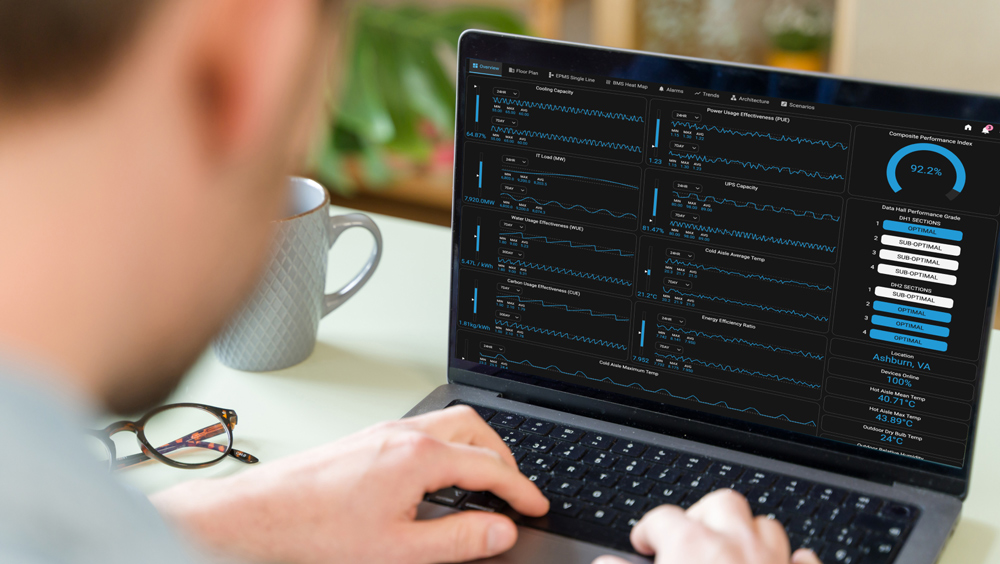
- An Electrical Power Monitoring System (EPMS) with interactive single-line diagrams, visualizing breaker status, real-time load, and alarm data to pinpoint power quality and capacity management issues.
- Advanced Building Management System (BMS) visualization, including thermal heat maps, historical data playback, and time-based alarm overlays for root cause analysis.
- Intelligent cooling management, with real-time monitoring of chiller plants and Computer Room Air Conditioning (CRAC) unit loads, redundancy checks, and automated alerts specifically tied to SLA violations.
- Unified performance scorecards as a single visual framework that combines multiple KPIs like Power Usage Effectiveness (PUE), Energy Efficiency Ratio (EER), and Uninterruptible Power Supply (UPS) load efficiency, alongside room-by-room performance analytics into a single visual framework.
- Full mobile-responsiveness, allowing operators and technicians to access data and respond to alarms from any device, anywhere onsite.
A DCIM architecture that unifies all of these subsystems transforms raw data into swift action to maintain compliance and energy efficiency. For example, if one room has an EER of 8 and another has a ratio of 1.5, it’s clear where inefficiencies are hiding. When UPS modules are detected as underloaded or unbalanced (a common cause of energy waste), the software provides actionable recommendations, such as redistributing loads or deactivating redundant modules to restore the system to its peak efficiency curve.

Improving Data Center Energy Efficiency
Energy efficiency is one of the most critical metrics in any data center, yet there is often a disconnect between design intent and operational reality. While a new data center build’s PUE target might be 1.25, real-world numbers often hover around 1.40 to 1.50 or higher, which can violate permit limits set by local authorities.
A robust DCIM platform bridges this gap by turning passive metrics into active adjustments. It highlights opportunities for load balancing, equipment redistribution, and UPS optimization. Often, the "low-hanging fruit" of efficiency is found in correcting imbalances. For example, simply rebalancing CRAC setpoints or redistributing IT workloads to restore N+1 redundancy can yield immediate results.
Crucially, DCIM visualizes electrical phase imbalance. As Matse notes, correcting this is financially significant: “By balancing, you will save a lot of money because the zero currents will disappear … your losses will be gone in this situation.” By eliminating these neutral currents, the facility reduces wasted heat and unnecessary load on the infrastructure.
Unlocking ROI Through DCIM Software
The Return On Investment (ROI) for a DCIM software that enables you to make these data-driven adjustments can be immense. For example, if a 15 MW data center reduces its PUE from 1.45 to 1.25, this can translate to over 1.5 million dollars in annual energy savings. “In this case, a DCIM system will have an ROI of a couple of months: three, four, five, six months, and you will comply with your local legislation. It’s worth the money to buy a DCIM, but really you should use it where it is meant to be,” said Martin.
DCIM tools also help reduce capital and operating expenses in other ways, including:
- Billing Accuracy: Identifying misconfigured meters, contract discrepancies, and energy usage gaps can recover 5-10% in unbilled consumption.
- Capacity Management: Matching infrastructure deployment to actual growth trends avoids overbuying equipment, lowering capital expenditures and ongoing maintenance costs.
- Regulatory Compliance: Automating environmental data collection and report generation reduces the burden of manual audits and helps meet sustainability mandates.
- Risk Reduction: Real-time alerts and automated failover detection prevent SLA violations and reduce the risk of costly downtime.

Why Ignition Is the Best Choice for Your DCIM
What makes a platform like Ignition ideal for building modern DCIM systems?
- An unlimited licensing model allows for scaling without additional cost penalties.
- Cross-platform compatibility ensures it can run in any environment, from on-premise to the cloud.
- Real-time data connectivity with a wide range of devices, from power meters to environmental sensors.
- Drag-and-drop dashboards that are mobile-responsive and customizable for different roles.
- A security-first architecture suitable for even the most demanding critical infrastructure.
By combining tools from the Ignition Exchange and industry packs, Ignition empowers data centers to rapidly prototype, deploy, and extend DCIM capabilities without being locked into rigid, expensive, proprietary solutions.
The Future of Data Center Infrastructure Management
As legislation continues to evolve and public pressure mounts for sustainable digital infrastructure, the need for intelligent critical infrastructure monitoring only grows. The good news is that the tools already exist to meet this challenge.
Ignition’s modern DCIM software gives data centers the operational insight they need to thrive in a more demanding landscape. Whether your goal is better energy usage, regulatory compliance, or improved reliability, DCIM is no longer a “nice-to-have” feature. It’s a strategic necessity.
Are you ready to optimize your facility? Explore how DCIM software can improve your data center operations and experience a full-scale example in action on the Ignition Data Center demo app. You can also go to our Data Centers Page to book a personal demo or try Ignition's unlimited free trial to start building your system today!