Inductive Automation Blog
Connecting you to ideas, tips, updates and thought-leadership
from Inductive Automation
Technical Keynote: What's New in Ignition 8.3
Rachel Bano
Mon, 10/28/2024 - 12:35



Traditionally, we've always held the Technical Keynote or Development Panel on Day Three of the conference, but this year, we've got something big to discuss, so we've moved it up to Day One of our conference content schedule. It's no secret that we've been working on the newest version of Ignition for several years now, and now we're finally able to dive deep into what's coming in Ignition 8.3 and how its powerful new features can lead users to their next big breakthrough idea!
Transcript:
00:02
Colby Clegg: Thank you. Thank you, thank you, thank you. Thank you. Welcome to the Ignition Community Conference, 2024 edition, Breakthrough. If you can't tell from the pictures, I'm Colby; that's Carl. I think we've been doing this so long, we're starting to look alike. I don't know. But we are very thrilled to welcome you here to Folsom for this week of discovery, learning, and collaboration.
00:37
Carl Gould: Yeah, this event is really the highlight of our year. It's our chance to get together with all of you and, of course, discuss what we've been up to this year. But at the same time, it's just as important for us to hear from you, hear what are your challenges, what are your successes throughout the year, and what are you most interested in right now? Because the collaborative nature of this community is really what makes ICC so special. So whether you're a returning ICC veteran or you're here for the first time, we're really glad you made it out, and we're looking forward to an incredible week.
01:11
Colby: Yes, and what a week it'll be. The pace of innovation in our industry has really been accelerating. It's an incredible place right now. Fundamental technological building blocks have been put in place over the last few years, are being used with new thought processes, new methodologies to build incredible, global, unified systems that are defining the future of automation right now.
01:25
Carl: And, of course, we see Ignition as a foundational part of this future, driving and supporting all of that innovation. And to that end, we're thrilled to be here this afternoon to introduce to you the latest major version of Ignition, version 8.3.
01:45
Colby: Indeed. Thank you. Yeah, certainly, in some regards, this release has been a long time coming. But from a different perspective, the new release is a culmination of a journey that we've been on for a few years. And Carl and I can say with confidence that we really feel that it is the right product for where the industry is at right now. So we can't wait to share it with you. Also, Ignition 8.3 is our most substantial and ambitious release we've ever done. I know we say that each time, but when you consider that the last time we did a major release, consider that our development team was about one-third of what it is now. So this is a substantial release, and we're gonna share a lot of it with you this afternoon by going over three key parts.
02:37
Carl: Yeah, and those three parts are applications, the historian, and our approach to infrastructure. And then, so we're gonna be out here giving a high-level overview of what's new in each of these three areas. And after that, Travis and Kevin will come out, and they're going to go over some examples of architectural use cases, and then after this keynote, right here on this stage, we're gonna be back for some deeper dive sessions going into what these... All these new features that we're about to go over are all about and how to use them. And then finally, we'll be back for a closing keynote on Thursday, where we'll touch briefly on what the future looks like beyond Ignition 8.3.
03:10
Colby: So with the agenda out of the way, we are ready to get started, but we wanted to take one moment just to talk about numbers, because I think that everyone here who's qualified to use our software knows that three does not come right after one. So very quickly, we wanted to talk about why we're calling it this with two key points.
03:27
Carl: Yeah, so the first is just that we really used the time frame that would have gone into developing what would have been a theoretical 8.2 just to make Ignition 8.1 all that much better. And the second one is that we use even numbers to represent releases that don't come with long-term support, and we don't think anybody wants a version of Ignition without long-term support, so we wanted to use another odd number. And those are both fine and accurate explanations, but it's also not a pattern that we wanna keep going with. So after 8.3, we're gonna be getting back to a slightly faster release cycle, roughly two to three years. Four was too long. And the next version will fix this numbering scheme we've gotten into.
04:07
Colby: Ignition XP?
04:09
Carl: Time will tell.
04:12
Carl: Well, let's call it Ignition XP.
04:12
Colby: Well, I got a few years to convince him on that one. But I'll tell you for now, a side effect of calling it 8.3 is that the three invokes perhaps the third part of a trilogy, which is really very much how we see this release. 8.0, 8.1, and 8.3 represent a philosophical progression towards delivering what was our ultimate vision starting a few years ago: to build a completely modern platform to support the next generation of industrial applications.
04:41
Carl: Evolving a platform like Ignition in this way is not easy. And historically, a lot of vendors in this space have really struggled with it over the long term. Continuing to innovate and stay modern while at the same time providing stability and continuity that this industry demands is pretty challenging. But we're proud of our strong track record in this area. We have a 20-year track record of doing exactly that. And 8.3 really continues in that tradition, promising a smooth upgrade experience as we have totally modernized the platform. In fact, when we think about our development process and how we approach what to include in the product and how to change it, we realize that there's really four key forces that we're always working to keep in balance. And those are innovation, continuity, stability, and security.
05:39
Colby: Taking the first two, innovation and security, both of these require constant evolution and change, and those fight against the desire for continuity and stability, which are paramount for plant floor operations. Really, there's one goal on the plant floor, and that is to keep running and keep running well. Well, stability is crucial here, as well as continuity, so that you don't have to continuously reinvent the wheel as new solutions come along. Typically in our industry, though, that has been achieved through the years by sacrificing innovation and security. Innovation is about bringing in new technologies to expand what you're doing, and security really often depends on your ability to evolve infrastructure, adapt to changing environments, and roll out security updates effectively. Balancing these four forces is a complex struggle, but as Carl said, we're very proud of the track record we've built.
06:26
Carl: Yeah, let's take a look at each one individually. So let's start with security. This year, we passed our audit for ISA 62443 security maturity level 3, which attests to the fact that our software development lifecycle considers security at every point along the chain. We also routinely participate in security conference competitions where we put Ignition up in front of security researchers who are highly motivated by some pretty sizable cash prizes to find new vulnerabilities in Ignition. If and when a new vulnerability is found, we're known throughout the industry for having a rapid response time and a transparent disclosure policy so that you can all be apprised of any new vulnerabilities that are found, including information so that you can evaluate whether or not your systems may be at risk, and if so, how to patch them.
07:17
Colby: In regards to stability, we've been working for the last few years to get to the place where today we're proud to say we have a one-to-one engineer ratio between software engineers and QA engineers. So that means that QA is an equal voice in the entire development lifecycle from inception to release. We also work hand-in-hand with our support division, which is in-house, of course, and the front line of our user experience. So support, test, and dev are all able to work effectively together to really be able to deliver changes in a timely manner.
07:52
Carl: Next up is continuity. Around here, backwards compatibility is always job number one, and we have the 20-year track record to prove it. There are systems in production today running the latest version of Ignition that have been continuously upgraded all the way from the old Factory PMI and Factory SQL versions 1, which was the software we had way before we even came out with Ignition. And we're able to do this because we take special care to manage our technical debt, which means that we can ensure that the platform itself is able to stay modern and doesn't get sort of bogged down by its own baggage. This is actually a huge part of the work that went into the development of Ignition 8.3 that should be mostly invisible. So it's not very flashy, but it really is an important point for creating the conditions necessary for this kind of long-term continuity.
08:44
Colby: Absolutely. And then finally, innovation. It's always been our philosophy to not create solutions in search of a problem. We always try to talk to customers and then create solutions that are practical and pragmatic. We also put special attention on creating features and solutions that have the broadest applicability possible and avoid going too much into vertical solutions. Finally, it's important to note that both the product itself and Inductive Automation as a company are the result of organic growth without a expansion through acquisition mentality. And so that helps the product to be much more cohesive and natively integrated.
09:21
Carl: Yeah, for sure. So we wanted to start our presentation this afternoon for 8.3 by highlighting these four topics because, by focusing on achieving balance with these four forces, our ultimate goal is that through Ignition, we can all help you balance these same four forces that are at play in all of your systems as well. But without further ado, let's get into what's actually new in Ignition 8.3 that should help you do just that. And let's start with the category of applications.
09:48
Colby: Yes, and let's start with perhaps the most obvious visual change as you start up a new Ignition gateway, and that is the complete redesign and recreation of our gateway web interface. So our design team reimagined our gateway configured interface from the ground up. We combined years of user feedback and experience with our own increased sophistication in UI and UX design to create an interface that is intuitive, easier to use, more scalable, and packed with clever features.
10:17
Carl: The navigation section of the gateway has been completely reimagined, resulting in a far more logical and structured layout. So items are easier to find, and configuration and diagnostic data have been combined together so that you don't have to bounce around between different sections any longer to both understand what's going on with your system and then also make configuration changes. This interface is also designed to work far more gracefully at scale, providing a consistently fast UI no matter how many items you've configured in your gateways and allowing for multi-selection, bulk edits, and an integrated search capability throughout the entire UI. So there's a lot of advanced functionality to discuss here, but we'll save some of that for the deep dive as we move on to the next UI-focused feature.
11:05
Colby: Yes, indeed. We're happy to announce that Perspective finally gets its own integrated drawing tools in Ignition 8.3.
11:17
Colby: So we've spent a lot of time, a lot of time, creating a completely bespoke drawing interface and making it really good, built entirely to work with Perspective.
11:28
Carl: Yeah, using the new built-in drawing tools, you can start with the existing symbols, you can import symbols from other systems, or you can just create symbols from scratch, all without leaving the designer at all. And the editor has all the kinds of drawing conveniences you would expect in a vector editing package, like snapping and guides and fill and stroke and path editing, layering, et cetera.
11:53
Colby: Best of all, since it was built from the ground up for Perspective, it has native binding integration, which means that you can connect the visual representations of your drawings to your real-time state throughout your system. We know this was a hotly anticipated feature, but it's not all that we have for Perspective.
12:09
Carl: No, not at all. Let's talk about forms. So, input and edit forms, a pretty commonplace part of any application. I'm sure building forms is something many of you who have application experience, application building experience, have spent a lot of time doing. It's kind of a mundane feature. Doesn't usually get a lot of attention, but we've, over the years, observed some patterns in how forms are built over and over again, and we realized that this was an area that was actually quite ripe for some improvement.
12:41
Colby: Yes. First of all, wiring together a form with labels, inputs, dropdowns, and so on is tedious and repetitive. Then, when you think about what should be done in regards to validation and intuitive user feedback, it gets even more laborious. So, of course, we realized we could save you a lot of time by creating a component that helps you with this. So now all you need to do is configure your form's sections, fields, data types, and validations in a declarative manner, and the component will take care of the hard work of making the UI for you, building the form's internal, the form's layout, internal validation, and client-side validation and feedback rules.
13:16
Carl: Yeah, all that automatic layout and having it be automatically mobile responsive, I'm really excited about this. But perhaps the most important part of the new form component is actually in how it deals with packaging up a data submission and sending it back to the gateway, which brings us to the third feature we have today for Perspective.
13:34
Colby: Yes, over the last five years, you've shown how Perspective can be used to create all sorts of applications. But there is one category of application that you haven't been able to create, and those are applications that have to be able to work without connectivity to the gateway.
13:52
Carl: In 8.3, this is no longer a limitation. So now you can design a Perspective application that is designed and built to work entirely offline. The intended use case here...
14:07
Carl: All right. We're glad you're excited also.
14:09
Colby: Somebody knows the use case.
14:11
Carl: Somebody does. The use case is intended for applications where an operator might need to drive somewhere remote, they have no connectivity whatsoever, and they need to gather some data, maybe fill out a maintenance form or read a meter. And in these kinds of scenarios, you'll be able to mark your Perspective application for offline use, arrive in your off-site location, launch it, fill out your form, and submit the data.
14:41
Colby: Yes. And once submitted, the form's data will be queued up, and when the device is later returned into a field of connectivity, that data will be synchronized behind the scenes automatically to the Ignition gateway that the project is connected to. So as always, when we add an additional feature like this, some fundamental building block that opens up a new category of application that can be built, we get very excited to see what you build with it.
15:06
Carl: Absolutely. Because we all know that Ignition is really all about data, right? Acquiring it, contextualizing it, storing it, building useful applications around it. One of Ignition's biggest strengths is all of the different ways data can be used and manipulated. And Ignition is called many things, depending on the context. A data hub, or an edge data collector, or a data ops platform if you wanna be trendy. It can be all those things because of all the different ways data can be used.
15:46
Colby: These are all data concepts that exist today in the Ignition ecosystem. They're technologies that all of you use each day to wire together data in and out and together in different ways. But as we continue to add more connectors and really look at the ways that data can be made more useful, we realized that we were missing a central unifying concept. And that's what we're introducing today with Event Streams.
16:05
Carl: An event stream is essentially a pipeline that maps event data from a source to a handler. Pretty simple idea. And like so many things in Ignition, that simplicity also relies on incredible power. Because inside of the pipeline, you're able to do all sorts of things with the data. You can coerce it and transform it and filter it, batch it up for efficiency's sake.
16:28
Colby: Yes, and both sources and handlers are extensible, which means that all parts of Ignition and modules can contribute them. So when we launch, we'll have sources and handlers for some of the most important key systems in Ignition.
16:45
Colby: That means that event streams are a bus for data in and out of Ignition, but it's also a bus for data inside of Ignition, and you can now connect together many subsystems in a very easy, powerful, and intuitive manner. That power will only continue to grow as we add new sources and handlers over time.
17:02
Carl: Yeah, the real power of this design is in the decoupled nature of these sources and handlers. So let's look at some examples of how this might be used. You might install the new Kafka Module and subscribe to a Kafka topic. Okay, so now events from Kafka are arriving in your gateway. You might also have the Sequential Function Chart Module installed so that when a new event arrives, it instantiates an instance of an SFC to handle that event using some complex logic. Now, the Kafka Module doesn't know anything about the SFC Module. The SFC Module doesn't even know Kafka exists, and yet here they are working seamlessly together through Event Streams.
17:42
Colby: There are really so many great examples we could give. For example, we came out with the MongoDB Connector a little while ago. Well, MongoDB has a cool feature called Change Streams where you can basically register a query and be notified as data changes. So imagine having a Mongo Change Stream observer coming into Event Streams where you're running a script or performing a calculation, or perhaps writing that data to tags.
18:06
Carl: You could pipe Ignition alarm events to an Amazon simple notification service.
18:12
Colby: You could have a whole chain with UDTs publishing changes to Kafka, which are then consumed by a set of front-end servers, for example.
18:21
Carl: Yeah, you can see we're having fun dreaming up all kinds of fun possibilities because the combinatorics here are really fun to play with. There's just so many possibilities.
18:31
Colby: Ignition has so much power in it now, and we're absolutely thrilled about how Event Streams gives us a new way to magnify that power in such a simple and intuitive manner. This new feature basically leverages all of the incredible features of Ignition to create a robust and capable stream processing engine. On the subject of data, you know what else people like to do with it in Ignition. They like to store it and a lot of it.
18:54
Colby: And so let's talk about our historian system. Our approach to history has always been as controversial as it has been successful. Unlock modern open technology to serve your history needs. Yes, we use SQL databases as our historian. Many people love to argue that SQL databases are not industrial time-series historians, but we found those tend to be the people selling industrial time-series historians.
19:22
Carl: What, it's true. What SQL databases do is enable you to use standard, open, well-understood, IT-supported technologies to store any kind of data. They're very flexible. Now, I'm sure there's more than a few enterprise DBAs spread amongst you that might be a little bit upset with us for the amount of data that ends up showing up in their databases that then they are responsible for maintaining, but you can't deny the fundamental benefits of this approach. Open data, industry standard tools, and technologies that your companies already have a lot of standards and expertise built around.
20:00
Colby: Yes, that said, since the first release of Ignition in 2010, we've been asked over and over again this simple question: When are you gonna build a real historian? Well, today, we're gonna answer that. We're not. Now hold on. I see some of you are trying to unbolt the chairs and throw them at me. Don't worry, I'm mostly trying to rile you up, and I actually do have something new for you shortly. But the point is, the answer is more complex than that.
20:27
Carl: Yeah, you know, in the last few years, there's been a lot of really exciting development in the open technology area when it comes to time series data. And a lot of this innovation has come from the consumer IT space, where concepts like IoT and the way the modern internet tracks every click and every impression hundreds of millions of users are making results in massive streams of time-series data. And so it's led to a proliferation of a lot of really interesting, robust, and open technologies becoming available in that space.
21:01
Colby: Yes, today there are so many incredible technologies available to store, analyze, and manage time-series data. When we look at that technology ecosystem and think the way that we have always thought, it strikes us that we don't wanna create another, some sort of new proprietary historian system. No, instead, we wanna make it possible to leverage all of that technology through Ignition.
21:26
Carl: But there's not really any kind of standard for all this different technology, like there is for relational data. So in order to help us leverage all these interesting options, we needed to first create a framework for building historian implementations inside Ignition around these technologies, which is what we've done for 8.3. In 8.3, we've totally rethought the approach to time-series history storage. And we've created a new public API that will allow us or any third-party module author to quickly implement new historian implementations and adaptations around these sorts of storage and querying technologies.
22:06
Carl: It has support for bulk storage as well as streaming data collection and the ability to store rich metadata models along with the history, which will help with the contextualization needed to support more advanced querying. It also supports key historian features like data annotations and native in-engine data aggregation and calculations, and many things like that.
22:30
Colby: Yes, so this means that Ignition isn't just a historian; it's a platform for building historians. And that may be a first in this industry. But I told you, we do have something new, and it would be the first implementation of this interface, and it's called the Ignition Power Historian.
22:47
Carl: So the Power Historian, it's an embedded in-process time-series historian that can store your data simply efficiently with minimal configuration. And we wanna be clear about positioning this correctly. So this isn't supposed to be a drop-in replacement for some grand enterprise historian solution. But it'll make a really big difference in what is becoming increasingly a very common architectural use case.
23:12
Colby: Yes, let's look at one very common architecture today. So virtually everyone is storing history into a SQL database. And the system uses store and forward to get the data there. Well, while the data is in store and forward, it's unavailable to the system. So for that reason, combined with local query performance, it's very common now for users to also add a local historian there in that gateway. And then use the Tag History Splitter to send data to both places. That tool, the Tag History Splitter, manages storing to both areas as well as querying based on timeframe.
23:47
Carl: So the new Power Historian really simplifies this architectural picture significantly. It can serve as a high-performance local historian, and it doesn't need the store and forward system in between the source of data and the Power Historian. It can then be used as a source to later synchronize to a remote historian for longer-term storage. So you can see how much efficiency and simplicity we get by adding this piece into the architecture. And real quickly, talking about performance, what do we mean? What are we expecting? So we've got some preliminary benchmarks out, and we have compared the Power Historian to both our local historian option we have as well as to a popular database system. And I just wanna pick out one key benchmark 'cause I think it's emblematic of the way this fits into the architecture, and that's really about the ingest rate capable with this time series system.
24:41
Carl: So this is a chart showing how many millions of data points per second can be ingested into the new Power Historian. And as you can see, it really blows SQLite and MySQL out of the water when it comes to ingest rates, which makes sense when you think about how we're trying to put it into the architecture and not require store and forward anymore because it's capable of keeping up with the data changes, and it's always local, so it doesn't have any network connectivity fragility in between Ignition and the Power Historian.
25:16
Colby: We'll have more benchmarks coming soon, but to summarize here these key high-level points, what we're talking about is a zero-config, self-maintaining time-series historian built into Ignition that is vastly more powerful than what's already available today for those solutions, that can act as a data source for enterprise data roll-up, thus simplifying architectures, that's part of a unified historian platform that supports richer data modeling and enhanced historian features, and by the way, is still open and non-proprietary in its data storage, and of course, is platform-independent just as Ignition is. So with all of that said, I'm sure you're wondering, Colby, that sounds great, but how much does it cost? To which I respond, nothing. We're including it in the Tech Historian Module. That means that everyone who has that module and has that upgrade protection will get this on day one with Ignition 8.3.
26:21
Carl: So again, this historian really shines when you view it from the lens of how it fits into bigger distributed architectures. So let's take a quick look at what the layers of those architectures look like.
26:35
Colby: This is a message we like to reiterate as we talk about these subjects. We really see edge, plant, and cloud, or perhaps you could describe them as edge, site, and enterprise, as a continuum where multiple levels work together in concert. Each of these layers has its own needs and requirements, but together, they form a homogeneous ecosystem. This is what we've been saying for years now and what we've been building, and we're gonna keep building towards this vision because we believe in it now as much as we ever have.
27:06
Carl: Yeah, and that philosophy can be applied to historical data as well. Each of these layers has its own requirements and its own opportunities for utilizing historical data. At the lower levels, you typically want high-resolution data stored for a shorter time frame in a system that is mostly autonomous and self-maintaining. And then, as you go up the stack, you enter into worlds where you might be aggregating and combining data for an entire region or even an entire company. And that demands a different approach. It demands more of an enterprise-grade engineered solution.
27:40
Colby: And this is a place where maximum flexibility and technological choice is vital. It's simply our philosophy that walled gardens are not the answer. Interoperable technology is. And that's what we're offering here with Ignition 8.3, a continuation of that philosophy. We've created an incredible site-level historian that provides immediate benefit. We've also created a framework for leveraging the world's best time-series technology on an enterprise scale.
28:09
Carl: Yeah, going forward, there's really a lot of incredible potential for us to continue building on this foundation and spanning from edge to cloud with this solution. But what we're offering in 8.3 is such a huge step forward for us, and we're really excited to continue to evolve it over the next few years. And now, let's move on to the final subject before we go into those architectural use cases, which is infrastructure.
28:34
Colby: When we talk about infrastructure, we're talking about how and where you run Ignition. But more importantly, we're also talking about the tools available to you to manage those instances and all of the different pieces that come along with it, the resources, the configuration, and so on. When you're building an HMI or a dashboard, you probably don't think a whole lot about infrastructure. But when you're using Ignition to do everything, everywhere, as we hope you all eventually will, infrastructure becomes fundamental.
29:06
Carl: Yeah, the subject of OT/IT convergence has been a topic that we've been talking about in this industry for a long time now, and we like to feel like we played an important role in helping to ignite that discussion because it's really a core part of our origin, why we even exist. Even before that term was in popular use, one of the first modules we came out with for Ignition was the SQL Bridge Module. What was it bridging? It was bridging OT technology in the form of OPC and IT technology in the form of SQL databases.
29:40
Colby: But at that time, it was really about unlocking value and functionality by leveraging the capabilities of IT software in the OT space. But true OT/IT convergence is far more than that. At the end of the day, it's about bringing together these two worlds that have vastly different engineering requirements and bringing them together to try to find a way to compromise those requirements and find an optimal way forward.
30:08
Carl: So what do we mean by that? On the OT side, as we've been saying, stability and continuity are paramount. Nothing should stop production, and the investment that you put into your OT projects has gotta last a lot longer than the average life cycle of an IT project does. But over on the IT side, you need to be able to manage these applications and systems as well-behaved citizens in your technology ecosystem. They can't be rogue agents or isolated islands that are not touchable. And of course, security is paramount because IT's gotta keep these systems patched.
30:46
Colby: Yes, today we're far beyond the idea that security can be achieved through isolation. And I haven't met anyone recently who doesn't believe that IT working closely together with OT is vital to create a better security stance in our industry. That means agility in responding to threats, frequent updates, and the ability to recover quickly should anything happen. Concepts that are typically far more comfortable for IT than for OT.
31:11
Carl: Yeah, our role is really a lot bigger than just letting you use some neat technology to send a ton of data up to HQ. If you want to achieve true convergence between operational and information technology as you're on a Digital Transformation journey, what you need is a platform that perfectly bridges the unique requirements of both sides. A platform for building OT applications on IT infrastructure. And that's what Ignition is. Hashtag, what the heck is Ignition? I finally figured it out, Colby.
31:45
Colby: I think that competition ended six months ago.
31:48
Carl: Too late.
31:49
Colby: Okay, but what does this mean exactly? What traits make Ignition so IT compatible? And more importantly, what does that mean today for Ignition 8.3? Well, first of all, of course, Ignition is platform-independent. This was a big deal when it was first released because at that time, not only was the industry completely dominated by Windows, far worse, it had become very, very sensitive to OS requirements. In fact, I just heard a story a few weeks ago about a plant that's still running a Windows Server 2003 machine in the corner because they can't upgrade it right.
32:22
Carl: I feel like we all have stories like this in this industry. They're far too common. But it's really not about Windows or Linux anymore. It's really just about being platform agnostic in the first place so that you can just conform to whatever technologies and platforms your IT department can happily keep patched and up to date, which again is vital for security. But Ignition's always been platform-independent. That's not new. So what's new today? Well, today, the discussion about deployment infrastructure has moved far beyond operating systems at all.
32:55
Colby: Yes, today's enterprises are managing resources on an incredible scale. And the technologies to help them manage those resources have really advanced in the last few years. Today, concepts like containerization, orchestration, infrastructure-as-code, and source control are no longer cutting edge. They're just standard tools of a modern IT infrastructure.
33:16
Carl: And there's plenty of ways to leverage these kinds of tools with all kinds of software, but it really works best when that software has native support for these techniques. And we've long been proud of how well Ignition works with these types of technologies, but that support hasn't really been complete in our minds until now.
33:35
Colby: Yes, with Ignition 8.3, we're completing the vision that we had years ago of building the world's most advanced and most IT-friendly SCADA system. So let's start at the lowest level and work our way up to see exactly what that means.
33:48
Carl: Yes, 8.3 really does complete the themes we started and set out within 8.0. So now, all of your configuration is stored in simple text-based configuration files, which means that everything in Ignition is compatible with source control systems.
34:11
Colby: Yes, in 8.3, we've eliminated the internal database, which means that all configurations, settings, project resources, even tags, are in simple and clean JSON, which means that they can be versioned, tracked, and managed with source control tools. Now, when we talk about source control tools, of course, those are very useful for engineering and the development lifecycle, but they also really help with standardization and resource reuse, because that means that all of these resources can be stored and managed and deployed using that tooling system.
34:42
Carl: Remember that shiny new web UI we looked at 20 minutes ago? Well, that web UI is completely powered by a new and modern RESTful web API. That means that everything you can do in that web API, all of that configuration management and diagnostic work, you could now do through an external agent. Furthermore, this API is totally self-documenting, and the documentation is embedded right in the product.
35:07
Colby: This means that Ignition instances can be programmatically configured and managed using standard IT technologies. We almost feel a little bad that we made the UI look so good because the most advanced companies may actually never see that configuration UI.
35:21
Carl: Sad but true. Moving on to what is often one of the trickiest, fiddliest pieces of infrastructure design, which is managing the build, test, and deployment cycle. So one of Ignition's most celebrated attributes is how quickly you can get in there and make changes. The designer's included, you can launch it, change things, hit that save button, and deploy a ton of changes right to production. But pretty quickly, as your project stabilizes and starts being critical in production, and as the teams who are collaborating in a single gateway grow and need to negotiate for resources, you wanna start developing a bit more governance around that deploy, test, develop cycle.
36:10
Colby: In an ideal picture, you would have developers making changes. Those changes would get sent over to a testing system where they'd be validated. Only after that would those validated changes be rolled out to a production gateway. The issue here is that your gateways depend on many, many external resources. And many of those resources may need to be different for each of these stages.
36:32
Carl: Yeah, so in dev, maybe you're using simulators, right? You don't wanna connect to the production assets from development, might be dangerous. Maybe in your staging environment, you have a replica database, not the actual database. There's always little differences between the environments, and that makes the deployment phase pretty challenging, reconciling those differences. And that's always been a challenge in Ignition, something that many of you have come up with a bunch of ingenious techniques to manage in different ways.
37:01
Colby: Yes, well, in Ignition 8.3, Deployment Modes are now a first-class feature. With Deployment Modes, the gateway is aware of which environment it's running in, called the deployment mode. So for example, dev, staging, or production. It's able to automatically change its configuration so that it can load the correct settings based on the defined mode for that gateway.
37:24
Carl: So the way this works is actually pretty simple. So as you configure different resources in your gateway, like database connections or devices, you can define different settings for different modes, and then the gateway will automatically load the correct settings based on which mode it's running in. So for example, if you have a database connection, and you wanna use one IP address in production and a different IP address in staging, you can do that. Those are just different settings for the same resource, active automatically in different modes. The gateway handles this all completely automatically, and to the rest of the system, it's one logical database connection that other systems depend on. So it's really a pretty simple idea, but again, once applied to the entire configuration system, it offers tremendous flexibility in your ability to build a sophisticated environmental deployment process.
38:17
Colby: I think I saw on the schedule that there was a table talk about this subject earlier. So if you weren't talking about this new 8.3 feature, well, this conversation will get easier now. So anyhow, we've just quickly covered a lot of very powerful new tools. Each one of these solves existing pain points and unlocks new potential. But to explore that concept a little more, the potential behind them, and then perhaps introduce even more, a few more new features, we'd like to welcome out here two people who know Ignition use cases probably better than anyone else in the world. No offense. That's okay. With that, please help me welcome to the stage Travis Cox and Kevin McCluskey.
39:02
Travis Cox: Hey everybody, I'm Travis Cox.
39:02
Kevin McCluskey: And hello everyone, I'm Kevin McCluskey.
39:04
Travis: You know, Kevin and I have been working together for years and I think at this point, we know each other well enough to finish each other's...
39:11
Kevin: Lunches?
39:11
Travis: Kevin, I said sentences, come on, man.
39:14
Kevin: Sorry.
39:17
Travis: Well, even though we work together a lot, we both play very different roles. In my role as Chief Technology Evangelist, I focus on spreading the word of success people are having with Ignition.
39:28
Kevin: And in my role as Chief Technology Architect, I get to work with Ignition users and our teams here at IA to ensure that our technology continues to meet the architectural needs of our customers.
39:38
Travis: So in other words, I help people dream it and to see the art of the possible.
39:43
Kevin: And I help them take the ideas that they have and do it in the best way possible for their businesses. And one of the reasons that we both wanted to talk to you about 8.3 is that we're both really excited about the possibilities that 8.3 open up for you, for your architectures today, and going into the future. We know that each of you is at a different step inside your Digital Transformation journey. And no matter where you are in the process, this release has something for you.
40:10
Travis: Absolutely, that's right. Ignition 8.3 is advanced enough for where you are right now and for where you wanna go into the future. Whether you're an Ignition newbie or you have many years of experience working with Ignition, 8.3 is gonna help bring the level and the power of your systems up to a whole new height.
40:29
Kevin: From the beginning, we've always wanted to leverage the latest and the greatest technologies. We're technologists, we absolutely love this, and you know, the whole company is, right? And we've wanted to expand Ignition's tool set so that you can up your game. 8.3 is a great example of that. Take advantage of what makes sense for you.
40:51
Travis: Yeah, Ignition always has been around answering questions like, can Ignition do this? Or can it connect to that? And these types of questions have evolved over the years. Now people are asking more questions around IT technologies than ever before. And the idea is to be able to answer the questions that are important to you. And the questions that people need answers to depends, though, on the level of sophistication they have with their systems. Now, when I say sophistication, I'm not talking about complexity. It's more about your Digital Transformation journey, and what part of that journey you're at right now. We've broken down Ignition 8.3, and this new release, into four different categories. And that is projects, data processing, system management, and IT. And today what we wanna do is talk to you about how the features of Ignition 8.3 help accomplishing your goals in each of these categories much easier.
41:41
Kevin: The first level is that of your typical SCADA application. If you've created a project that uses Perspective, Tag Historian, SQL Bridge, and you're doing very sophisticated things inside a single Ignition gateway or redundant pair, what you see here might represent you. In this example, it's advanced project design doing a lot of really cool things with this relatively simple architecture and without wider, company-wide data flows. If you're doing an IIOT system or using Ignition communication layers like MQTT or more Ignition gateways in a scale-out architecture or multi-site architecture, your complexity might look a little bit more like this. And if you're doing a full enterprise system with hundreds of locations, multiple connections, advanced deployments supported by orchestration and supported by IT departments, your sophistication level might look a little bit more something like this, where it's high across every category.
42:37
Kevin: Everyone's at a different stage inside their sophistication level and inside their journey overall. So to help understand how 8.3 can make things easier, no matter where you are on this journey, we're going to show you which of the features that Carl and Colby just talked about are going to be the most useful at each of these levels of sophistication, starting with projects.
43:01
Travis: Right, so the first area is project sophistication. And these are tools that help you build better projects, especially around SCADA. So let's say you're a brand new user to Ignition. Building a complete SCADA system is easier than ever with the new Power Historian. You can simply deploy a single Ignition server and everything's up and running. You can connect to all your devices, you can log all that data to the Power Historian, you can build up your applications and launch clients very quickly. There is no need to install any separate software.
43:35
Kevin: Yeah, so a lot of folks are used to having Ignition with a SQL Database right alongside it, even for simple applications. You can still do that, of course, and we do encourage it for more complex systems. But if you're just dipping your toes in the water of Ignition, so to speak, and you wanna spin something up really quickly, having a Historian built in along with charts and graphs and the other visualization tools all inside Ignition, that new Power Historian makes it really easy for new users to roll that type of thing out.
44:07
Travis: Yeah, and now let's say that you're an existing user and you already have a system up and running. 8.3 adds the ability to connect to more devices with the addition of the Siemens S7+ Driver. Siemens PLCs are becoming way more popular and we're seeing them used for a lot of new projects that are out there. We wanna make sure that Ignition has the relevant drivers for you to do your job.
44:30
Kevin: That's right. With a lot of folks who are using the newer Siemens processors, this is a really big deal because it allows you, if you're connecting to those processors, basically, you understood and been using symbolic addressing and you've been using some of the optimized block addressing and probably, I don't know, 20, 30% of folks inside here have struggled with that in the past, right? With the new driver, you don't have to worry about using third-party drivers or manually configuring tags from a spreadsheet or connecting to and reprogramming and changing some of those options inside the existing Siemens PLCs. This new driver just connects immediately, allows browsing, and really speeds up the time to deploying Siemens-based projects.
45:17
Kevin: And another thing that's really easy to connect to in Ignition 8.3 is Twilio Voice and WhatsApp. With native integrations to these two services, you can send out notifications to the people the way that they want them.
45:30
Kevin: Ignition's existing notification system can already send things out to SMS, email, voice over SIP or voice over hardware, get one of those boxes and go through that. We've got the Grandstream and a couple others that we recommend there. These new notification options expand out on that more to give you more services, which really gives folks a lot of great additional options here. IT loves these for a couple of reasons. They're simple, and they also reduce that need for physical hardware. It reduces or eliminates that footprint on-premise.
46:05
Travis: I'm really excited about these features, but I gotta tell you, I'm really excited that we can, for the first time, actually draw a circle in Perspective.
46:16
Kevin: Travis. Ah. What is it that they say? Sometimes the simplest things are the ones that matter the most. Seriously, though. Perspective Drawing Tools, not Perspective Circles. We know people have been asking for this for a long time. We're really happy that we're providing this first-class, state-of-the-art drawing tools that you saw earlier directly inside Perspective.
46:42
Travis: For sure, and this feature's really gonna get us to get people the confidence and the speed to build full HMIs with Perspective to really take advantage of the most amazing, the most advanced visualization system on the market today. So, like Carl said earlier, Perspective, there's a lot of new tools that are coming in there. And in addition to drawing tools, Perspective's also taking forms to that next level. There are a lot of customers out there that need to collect data in remote locations that have very limited or no connectivity at all. And this makes it really challenging to collect inventory or sample data and get that information back into Ignition. And we've all had to do this before by building custom-built solutions. That is very difficult to maintain over time. This new form component and offline capability, it gives you the ability to do that so easily. It's gonna be a game-changer for data collection possibilities inside of Ignition.
47:33
Kevin: I've built a lot of forms in Ignition over the years, as I know a lot of you have as well. And I can tell you that there's a substantial amount of time that goes into building good forms. 8.3 is going to make that so much faster and easier for folks to build forms. And when you combine that with the forms offline mode, it's going to be a really nice experience for building projects, especially things that are replacing clipboard entry or some of the traditional types of forms that people would be walking around and filling out. You can do that inside Ignition in a way that is quick, economical, easy to implement. We have a bit of an internal mantra. It's "First make it possible, then make it easy." This is a perfect example of doing just that, where form applications inside Ignition were possible before, and they were good. But with these new features, we think they're really gonna be great going forward.
48:31
Travis: And I think we could expand that mantra to a lot of the features that 8.3 is bringing. So all of these tools here, they really help you in building better SCADA systems, and they give you more tools inside of Ignition that you can take advantage of to accomplish your project goals. Now let's move on to the second area of sophistication here, and that is with data processing. So everybody's level of sophistication with data processing is changing all of the time, right? Customers wanna make the most of their data, especially with getting data to the business. Well, with more devices we wanna connect to, more systems we wanna integrate with, and of course, more places we want that data to actually go, 8.3 is gonna help people up their game in data processing. First off, in 8.3, OPC UA is getting some updates. Now you can actually securely share specific tag data to specific places or clients.
49:26
Kevin: Yeah, with tag sharing, it's really nice. You can pull in a set of tags for a specific system to share them with a third-party OPC UA client. This allows other systems to get data that they need from Ignition without sharing more tags than you want to. We're also updating the OPC UA stack to the latest Eclipse Milo version, supporting OPC UA 105, and additionally, we're going to be adding OPC UA events to Event Streams so we can easily handle events coming from OPC UA.
49:54
Travis: And of course, that brings us to Event Streams, which I personally think is gonna be a huge game-changer. It's gonna really accelerate the movement of data from OT systems into business systems than ever before. We're gonna be able to leverage the full power of all the connectivity options that are in Ignition, from OPC UA, MQTT, SQL, of course with the new Kafka connection, and a lot more. Now speaking of Kafka, that is the standard enterprise message bus for almost every large company in the world.
50:25
Travis: They use it to talk to ERP systems, scheduling systems, and a lot more. And with Event Streams, Ignition's collection with Kafka is gonna be first class. Event Streams allows you to move data in unique ways without writing a single line of code.
50:39
Kevin: I'm really excited about Event Streams. This is one of the features that I've been talking to everybody at Inductive about for quite a while here. I think it's going to be a really significant feature, and I'm seeing it in two different ways, right? That it's useful for two different types of folks inside an organization. One would be the folks who use Kafka or other IT message-oriented platforms. It's gonna make Ignition really easy, as you saw earlier, and Carl and Colby were talking about, really easy to bridge that IT/OT gap with the right tools built into Ignition. The other category is folks who are using Ignition for tag change scripts, using Ignition in other places, and they wanna manage changes or events that are happening centrally in a way that everyone who's designing inside Ignition has access to. An event happens; could be a tag change, an alarm change, something in the database triggers it, and you wanna respond to that event inside the SCADA system directly. Event Streams are gonna be a fantastic way to do that directly inside Ignition.
51:40
Travis: With all of these tools, Ignition continues to accelerate building UNS architectures. You know, you hear a lot about UNS today from groups like 4.0 Solutions and Sesame. Ignition allows you to provide a single source of truth of your operational data that is clean and contextualized.
51:58
Kevin: You can easily contribute to a UNS of your choice, Unified Namespace, right, whether that's a pub/sub system like MQTT or Kafka, storing that data at a warehouse or anywhere, really, with context. Not only that, Ignition can also easily access data from a UNS system, providing dashboarding and visualization to anyone.
52:22
Travis: So in 8.3, there's a lot of new connectivity options and tools to help users accomplish their data processing goals. Now, of course, systems are getting a lot larger, and with larger and bigger systems comes a need to have better management. And there are a lot of great tools in 8.3 that are gonna do just that, and let's start with the deployment modes that Carl mentioned earlier. A lot of people are developing on a single production server, and they've started out with that; they've built a small system, and over time, they've built that up, and it's scaled up to be a very big system.
52:55
Travis: That became a critical system for that company. And at that point, making changes to a production environment is risky, right, and it's not the best practice. So really, it's about adding a development environment, and doing that now with 8.3 is easier than ever with this new deployment mode.
53:11
Kevin: The idea is that you have separate environments, Carl and Colby; if you were paying attention earlier, this looks very familiar, of course, but just to go over it again, right, the idea is to have these separate environments that you have different changes, and you might develop new changes that have differences between production, between your development system, between your QA system. And that production environment might have real PLCs, the development environment might have simulator PLCs instead of real ones; different SQL databases; more things like that.
53:39
Kevin: This feature allows us to define the configuration for all the different environments inside that single Ignition server. It means we can deploy one backup containing everything to multiple different environments. You don't have to worry about merging your changes from one environment to another, plus you can define the deployment modes that you want.
54:04
Travis: So now you can actually have a true development environment where you can build all the configuration for everything, you can test it out in a safe way, and you can deploy, of course, when you're ready.
54:11
Kevin: To deploy, you can simply take a backup from the development server and restore that to the production system manually, or if you wanna use source control, you can push changes from a repository and pull them into production when you're ready.
54:26
Travis: Exactly, and change tracking is incredibly important. In Ignition 8.0, we dipped our toes into that, right? We started making this easier when we moved the projects into the file system, but it was just the projects, not the rest of the configuration. But people wanna track everything, right? And with 8.3, all the configurations in the file system, and this is a big deal to make change tracking very simple. So now you can do it in a first-class way using systems like Git, which is really the most popular system around and the one that folks are trying to use and getting information about with us.
55:00
Kevin: If you've ever tried to use source control systems with the SCADA system, you'll know that some things get tracked and others don't, and others end up in binary formats that might be hard to work with. Sometimes it's kind of terrible. So, but you know, honestly, with the way things are set up with 8.3, it's amazing now. So behind the scenes, the changes, for moving everything to disk, having everything stored in configuration, that's JSON files, the internal database going away, and switching that all out, you can track everything. So if you're taking a look at project versions, you can see what changed, when it changed, what system it changed on. And Travis mentioned Git. A lot of folks use Git, but you can use other systems as well, since everything is file-based. So anything that plays with a file-based storage system is going to play well with Ignition.
55:50
Kevin: Now, if we combine source control with deployment modes, like we were taking a look at just a minute ago, it's easier than ever to track your changes and have that true environmental separation at the same time.
56:05
Travis: So with things like deployment modes and change tracking, handling more sophisticated levels of system management is easier than ever with 8.3. Another thing that's gonna be easier is working with IT departments. Increasingly, we're seeing OT and IT teams working together, especially to better manage OT systems. And IT wants to be able to help, not only by helping with system management but also by integrating with IT tools to help enhance a system and follow established best practices. So at this next level, we're gonna talk about the IT tools that 8.3 can easily integrate with, and the first one is with Secrets Management.
56:43
Travis: So Secrets Management is where you can pull out all of the secrets from within Ignition. These are the passwords, the credentials, and put it into a secrets vault that can easily be managed. And it can also handle encryption keys and certificates. Now, this has several major security advantages.
56:58
Kevin: Yeah, so for example, say IT sets up a Microsoft SQL Server database and gives you a service-level account to it. You know, a few months later, maybe they come and they want to change the password. Oh, without Secrets Management, it could be a daunting task.
57:14
Kevin: I think we've all been there, right? I certainly have, and you know, a lot of folks simply push back and might actually win that battle and not do it and have that password just stay the same because they don't wanna change a production system. You know, that could also be a potential security risk if that password ever gets compromised. By putting passwords inside a secret spot, they become much easier to manage; auto-rotation becomes something that can be automatically done, and it mitigates a lot of that risk. However, the biggest advantage here, in addition to that, really, is taking secrets out of Ignition's configuration. So let's go back to that example of setting up, you know, IT setting up that database.
57:58
Kevin: If they give you credentials to that database and you put the credentials into Ignition, then one day you need to send that gateway backup to us for support or you start working with a new systems integrator. Those credentials are included in the backup. If you're using secrets management and externalization instead, that won't happen because the credentials live in the secret manager that's outside of Ignition and they're simply used by Ignition.
58:21
Travis: Another area that IT can help is with deployments. You know, recently we've seen an increase in the number of devices that Ignition's being deployed to on the plant floor, right, with the proliferation of the edge. And as a result, we've seen the use of containerization grow incredibly fast. I wanna bring up a couple of other updates here about containerization. First is that we're actually bringing Ignition Cloud Edition to the container marketplace. So, on AWS, so Amazon ECS will now be available to spin up Ignition Cloud Edition instances.
58:52
Travis: And we're working with partners like CradlePoint and Digi and others who have orchestration platforms of their own, allowing Ignition to be deployed simply with one click using their marketplaces.
59:04
Kevin: This makes it really easy to get containers deployed on-premise and in the cloud because you're not having to install software anywhere. Basically, so, as you know, we've always said that Ignition has a three-minute install. It's one of those other mantras that we have, which it still does when you're installing in the traditional way. But with containerization, Ignition is a 30-second install, and that's with a full system, with configuration, with connections, all of that. It's just built in. Containerization is pretty incredible and enables a lot of things that we'll see in the next couple of slides here as well.
59:40
Travis: So now, when it comes to being able to deploy a lot of Ignition systems and then send out fleets of configuration changes or being able to manage it from third-party tools, the new REST API is gonna be another game-changer. I think I'm saying that a lot here today. But with tools like, using tools like Ansible to be able to access status and configuration or any other third-party tool that IT has, they can use the tools that they're comfortable with, they can get information from Ignition, they can create their own alerts, and they can manage Ignition the way that they want to.
1:00:11
Kevin: As you can tell, we're going up in sophistication level here, and not everyone's going to end up using this feature, and that's okay. But for those of you who are familiar with REST and web services, this is gonna be a really nice feature. And if you're not at that level yet but you want to get there, this is gonna be here to help you and make it easier when you're ready. The REST API will also help with wide-scale deployments and orchestration, which is the next feature we'll talk about.
1:00:36
Travis: Yes, so we talked about containerization and being able to deploy a Docker container. But there's a lot of IT departments that are setting up Kubernetes clusters both on-premise and in the cloud, and they want to deploy Ignition through that. And with Ignition 8.3, we're doing something that's pretty unique here, Kevin. So what the helm are Helm charts?
1:00:57
Kevin: I see what you did there. So Helm charts, I'll reset for a second. Helm charts are these fantastic configuration files. If anyone's ever worked with AWS CloudFormation scripts or other systems that fall under that wide catch-all phrase of infrastructure-as-code with scripts that set up architecture, Helm charts are another example of that. They're not only some basic configuration scripts, but they can go pretty advanced, and they also are fully cross-platform. So they're not specific to any specific cloud provider or set of infrastructure.
1:01:33
Kevin: Helm charts are for this system called Kubernetes that probably most folks have heard of. It's the most popular orchestration system that's out there, and it can really help with these large deployments.
1:01:44
Travis: So for example, if you wanna spin up several Ignition gateways, or you wanna spin up a scaled architecture or any other deployment that you'd usually install Ignition on a number of different places, and of course connect them all up together, these Helm charts are gonna make that incredibly simple.
1:02:03
Kevin: And we're releasing many of these. We'll have a lot of Helm charts and Helm chart options that are built into the Helm charts that'll allow for a lot of different configurations and going to make it really easy for folks to use Kubernetes to quickly spin things up, spin things down, move them around, orchestrate things in a way that requires less work. We're releasing them with 8.3, so when 8.3 is released, all of these Helm charts are going to be released along with it.
1:02:31
Travis: So as you can see, no matter what the sophistication level of your system is, Ignition 8.3 has answers to questions that you are facing. And the next question you might be asking is, okay, Travis and Kevin, when can I start doing this stuff? When can I start getting access to 8.3? So let's talk about that.
1:02:50
Kevin: I'm glad you asked, Travis. So happy to announce the beta's gonna be available soon. We're looking at a December release, so we're targeting that. Look at the forums if you wanna participate. You can go there; there's information there, and there's also going to be feedback that's going back and forth through the forums. Some of you asked about a private beta, and we have a list of folks who are interested in that as well. And what we decided to do is basically take a look at the release, and when it's good enough for a private beta, we're instead going to make that a public beta for everyone. So everyone's going to be able to get access to that.
1:03:28
Kevin: That's happening in December, and so stay tuned for that. Also, during the beta period, we'd like to ask you, please keep the feedback contained to the forums. So please don't call into tech support with your 8.3-specific troubleshooting steps quite yet. The forums, the folks on the forums are the actual developers who built the 8.3 features, and so they're really best equipped to be able to help you.
1:03:53
Travis: And once it's released, we'll be back to our regular five-week coordinated minor release cadence. That's our release train that we have. Expect releases of 8.1, though, to slow down significantly, as we only plan on releasing patches for security, vulnerabilities, or critical bug fixes that we find.
1:04:18
Kevin: As far as support goes, as mentioned earlier, 8.3 is a long-term support release. That means active support for five years from the release date and two years of limited support following that. In case you're not aware, active support is support from our development team. It covers additional features, bug fixes, and security updates for the lifecycle. It also covers support from our technical support team via email and phone. Limited support is a two-year period right after that, where our development team is no longer providing updates for the software. Because of that, we always recommend upgrading before this window. But if you miss the date, that limited support, it provides limited email and phone support. You can see in the diagram that there's a great overlap window between the two, right? We're giving two years between 8.1 and 8.3, so there's plenty of time to plan an upgrade.
1:05:10
Travis: Right, which brings us to upgrades. So let's talk about upgrading to 8.3. The reality is that 8.3 brings a lot of amazing new features everybody wants to take advantage of, and they're gonna wanna upgrade as soon as it's ready. Now, of course, 8.3 is perfect for a brand new projects. So any new project out there, go ahead, start using that. Now, if you're already on Ignition 8.1 and you wanna upgrade to 8.3, the upgrade's gonna be seamless, right? Carl talked about that we want the backwards compatibility to be there all the way. That is certainly true with this release. And you can simply follow our upgrade guide when it is released. Now, I've got a lot of confidence in our release process, but of course, a trust but verify approach is always prudent for upgrading existing production systems.
1:05:53
Kevin: And if you're upgrading to 8.3 from an older version, you'll need to upgrade to 8.1 in order to upgrade to 8.3, go through a two-step cycle there. So if you have 7.9 or any other earlier system, 8.1 or even before 7.9, now's the time to upgrade them to 8.1. So 8.0, 7.9, 7.8, whatever it happens to be, you'll wanna hit 8.1 so that you're ready to do the upgrade when 8.3 comes out.
1:06:20
Travis: Now, individual system upgrades should be seamless. Full system upgrades with multiple Ignition gateways are also seamless, with the notable exception of the gateway network connectivity. 8.3 will communicate with 8.1 gateways, but not prior. So this is because of our updates to our encoding formats that we use to help improve our security posture.
1:06:46
Kevin: Good news, if you are purchasing today, anyone who purchases a license with any support plan from us, basic care, priority care, total care, it doesn't matter; you're covered for 8.3; it's guaranteed that that license is going to work for 8.3. If you have licenses today that aren't under support, you can add support right now, and you'll be ready for 8.3 when it comes out. And if you have, for example, end-of-year budgets that you're looking to spend or a project that's gonna be happening soon, now is really a great time to get lined up with that 8.3 guarantee. Just make sure you include the support plan when purchasing.
1:07:21
Kevin: So we've covered a lot this morning. Incredible new tools like the Power Historian, Event Streams, Perspective Drawing Tools, rapid form building, offline data collection, along with a slew of connectivity features and enterprise tools for customers who can use them. I am really excited about 8.3, and I can see that a number of you are as well. I know you are too, Travis.
1:07:44
Travis: I am unbelievably excited. I'm like a kid in a candy store.
1:07:49
Kevin: There's so much packed in here.
1:07:50
Travis: For sure. So we really hope that during our presentation today that you've heard something about 8.3 that inspired you for your next breakthrough idea. And we have some more to share with you later today. After this keynote, we're gonna have two breakout sessions this afternoon, which will go into deeper dives in 8.3 for the platform and the features. So if you wanna learn more, please make sure to stay here on stage one throughout the rest of today.
1:08:17
Kevin: Digital Transformation is a journey, and every journey is traveled one step at a time. I hope that you see that whatever and whenever the next step is for you, Ignition will be there along with you to make that next step easier. Wherever you wanna go, Ignition is the foundation for the future. And wherever you are now, there is something to get excited about with Ignition 8.3. And as always, we're really excited to see the projects that you build with this amazing new technology. Thank you so much for coming. Have a great time at ICC. Thank you.
Wistia ID
53f4zqrjcc
Topic
Hero
Thumbnail
Video Duration
4142
Featured in Sort
On
Subtype
Speakers
Colby Clegg
Chief Executive Officer
Inductive Automation
Carl Gould
Chief Technology Officer
Inductive Automation
Travis Cox
Chief Technology Evangelist
Inductive Automation
Kevin McClusky
Chief Technology Architect & VP of Sales
Inductive Automation
ICC Year
2024.00
Main Keynote: Exploring the Impact of the Ignition Community
Emily Batiste
Fri, 10/25/2024 - 10:01
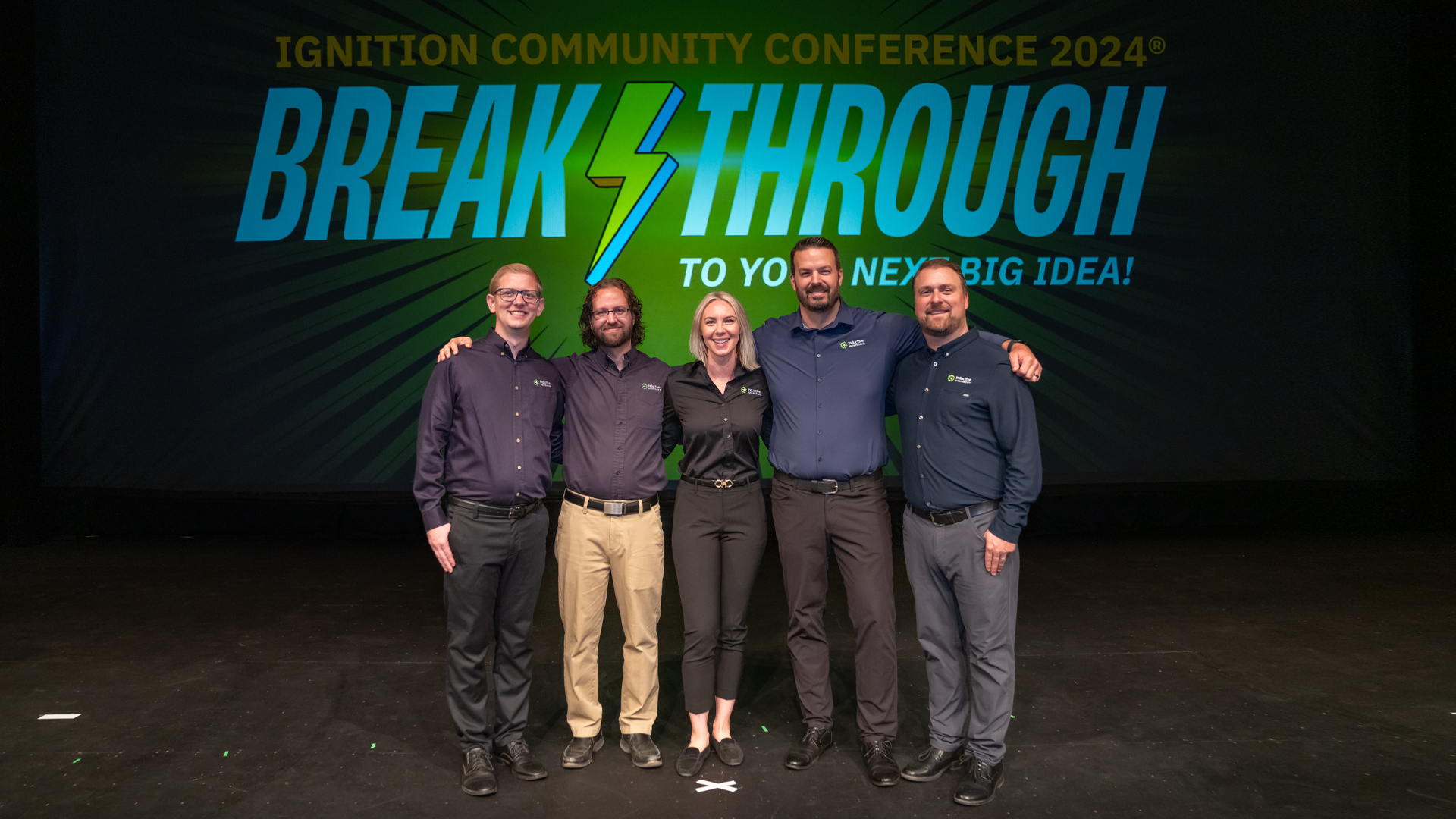
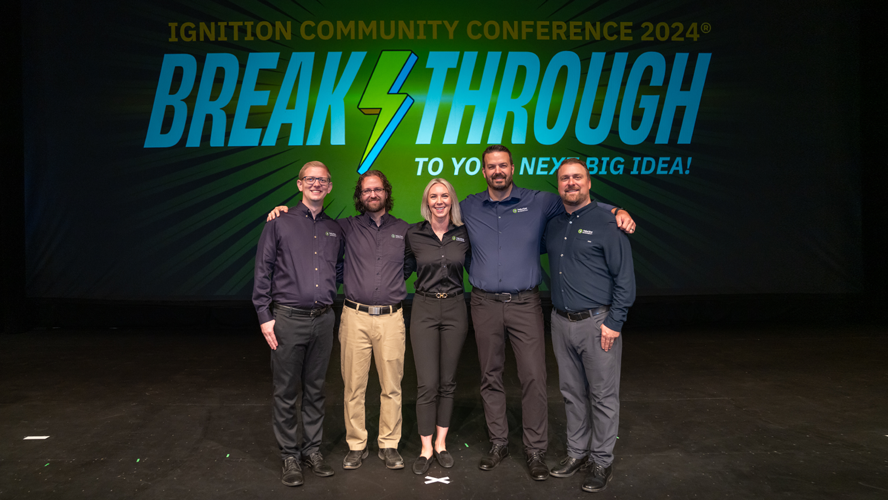


The global community of Ignition users includes large multinational enterprises, government and professional organizations, small companies, and individuals. While each uses the software differently, they all use Ignition to harness the power of automation to accomplish their own mission of making something better. In this keynote, we'll explore how Inductive Automation is supporting the efforts of the Ignition Community and the incredible impact their work has on the future and improving people's lives on a regional and local level.
Transcript:
00:06
Kat Jeschke: Good morning. Welcome back to day two of the Ignition Community Conference. Who here had a great day yesterday? Good. We did too. This year, we have three keynotes for you. Yesterday's [Technical] Keynote focused on the software. This morning's [Main] Keynote will focus on you, the Ignition community, and tomorrow's Closing Keynote will focus on what's next for Inductive Automation. I'm so excited to be here this morning to talk to you about what's most near and dear to my heart, which is all the people of the Ignition community. Yesterday, you saw the incredible work our teams have been doing on [Ignition] 8.3. Our software is made by people, supported by people, and used by people. The whole reason we exist as a company is to make people's lives easier and better. My passion is to empower people and to keep this community strong. This morning, you are going to see some amazing examples of the impact this community's having on people's lives. I'm so proud of all the work you've been doing. We're gonna show you some amazing companies and community members who are making a difference across the world.
01:27
Kat Jeschke: Since we started hosting this conference 12 years ago, we've been amazed and inspired by this community's tremendous impact on the industrial automation space. We'll examine those positive impacts this morning by looking at the award-winning projects in this year's Discover Gallery. We'll also look at how Ignition is being used to make meaningful impacts in local communities. After that, I'll be back on stage to discuss what Inductive Automation is doing to continue supporting the success of this community. So to kick things off, I can't think of anyone better to talk about this community than Inductive Automation's Chief Technology Evangelist, Travis Cox.
02:19
Travis Cox: Good morning everybody. Hey, I'm so excited to be back here. Had a great day yesterday and I'm excited to be back on stage here today to talk about what this amazing community is doing today. So in my job, I work with all kinds of professionals. I speak with people who have been using Ignition for years, and those who are brand new to it. I work with people who use Ignition at big companies, and I work with people who are using Ignition on their home automation systems. One thing they all have in common is that they are using the power of automation to improve something. The old definition of automation is about using technology to replace human labor. But automation isn't about replacing people, it's about empowering them. Automation is a force multiplier that empowers a single person to make a huge impact. It enables people to tackle the world's biggest challenges on a massive scale.
03:13
Travis Cox: And all of our lives have improved because of this. Automation has helped improve our living standards by supplying billions of people with food, water, energy, and medications. It's opened up the use of new technologies to more people, enabling millions to access new forms of computing and communication. The benefits of automation have vastly impacted lives of every single person inside this room and beyond its walls. And all of these benefits are made possible when a single great idea is multiplied by the power of automation. At Inductive Automation, we always believed in the power of that idea, and that's why our motto is Dream It. Do It. A person's idea can be a fleeting thought that never gets the chance to be realized without taking action. Or it can be an idea that changes people's lives. The difference between those two possibilities is people's power to turn their ideas into reality.
04:17
Travis Cox: So for us, Dream It. Do It, isn't just a catchy phrase, it's a fundamental part of our philosophy. We believe it's the doers who make things happen, and that's because the people who are willing to take the first step into the unknown are also the ones who discover a better way forward. When our founders started down this path over 20 years ago, our product, company, and this Ignition community were a little more than a dream that would never have been realized without taking action. In our early days, many in the industry laughed at us. They couldn't imagine that we could break through a software category with entrenched competition, but here we are.
05:03
Travis Cox: What they didn't realize or understand was the frustration of so many people, integrators and engineers, who wanted to do more with their automation systems but couldn't because the limitations of the software tools back then. Many of the pain points of using old SCADA software were about limiting access, making things closed, proprietary, confusing, expensive, locked down. We believe that these limitations kill ideas and limit the good that automation can do. With Ignition, we've always strived to open up the benefits of automation to more people, and that's why it's cross-platform. That's why it's based on open standards. That's why it has a flexible, modular architecture. And of course, an unlimited licensing model. And that's why a few years ago, we launched a new release of Ignition, the Maker Edition, so that people can use it for non-commercial use, allowing more people to use Ignition at home or to learn it at university. That's also why we created the Inductive University. I can't believe that it's been 10 years since we launched the university right here on this stage. And I gotta tell you what, they're never gonna let me live it down.
06:31
Travis Cox: But we created IU with the goal of allowing anyone to learn Ignition at their own pace and of course, for free. And that's exactly what it's accomplished. And let me tell you, the results have been staggering. Since its launch in 2014, there have been over 10 million views of IU videos. It has almost 8 million challenges that have been taken. There have also been over a 100,000 new users accounts created, and 30,000 credentials that have been earned. Can you believe that? It's amazing what this tool can do for the community. That's hundreds of thousands of people who have gained access to new knowledge to help them turn their ideas into reality. We've always believed that the best way to help people is to empower them with the tools and knowledge that they need to do what's right for their customers, their companies, and of course their communities.
07:29
Travis Cox: At Inductive Automation, our mission is to help you accomplish your mission. And there are thousands of companies in over 140 countries worldwide who are doing just that today. Ignition is used in every major industry. It's used for SCADA, HMI, MES, IIoT, and much more. It's used for massive enterprise systems with millions of tags and small implementations at the edge. Ignition is being used to help people enjoy the benefits of automation, more benefits than ever before. Using Ignition, thousands of end users are improving their processes and people's lives in meaningful ways, but none of that is possible without this community here. Fueled by your ideas, Ignition is an enablement platform for harnessing the full power of automation. And this year, we've seen this community using Ignition to accomplish some incredible things. And the best place to see that is right here in the Discover Gallery that we have with the conference.
08:35
Travis Cox: The gallery showcases real Ignition projects from around the world, and every year, we ask users to submit their best projects to be featured in the gallery here at the conference. If you haven't had a chance to check it out in the black box, I encourage you all to go and look at all the projects. They're also available on the the website for the Ignition Community Conference. Now, we're gonna look this morning at several of these Discover Gallery projects, but know that for every project that we talk about here in this presentation, there are many more brilliant projects that you have to go and check out. So please make sure to go and do that. But it was really amazing, this year, we had a record number of projects that were submitted. There were over 80 projects that were submitted from all of you, and that covered a range of industries and different use cases. We saw projects in automotive, pharmaceutical, agriculture, government, utility, water, energy, and a lot more. And every year, we recognize the companies that submit the best projects with a Firebrand Award. Now, this year, the six organizations who are receiving a Firebrand Award are NeoMatrix, CertainTeed, Deloitte, Madkour Group, IDOM, and the Fermi National Accelerator Laboratory. Let's give all of these award winners a round of applause.
10:00
Travis Cox: So one aspect of this year's Firebrand projects that inspired us is how each of these end user organizations is working to make a positive impact on the world by improving people's lives and sustainability. And this morning, we're gonna examine how the work of this community is impacting both of these areas, starting with creating a more sustainable future. The future doesn't just happen. We need to create it. What we do today will pave the way for tomorrow. For those people like us who work in industrial space, we recognize this fact more than most. Today's raw materials can be transformed into amazing solutions that we're gonna need tomorrow. But there's a lot of hard work that needs to go into it. When working on the industrial automation processes, we always have to start with the projects with the end in mind and think about the result that we want.
10:52
Travis Cox: The process of getting to that end product is critical, and of course, an inefficient process will result in waste, loss of productivity, and ultimately a poor outcome. But to get better results, we need to improve our processes, and that's what sustainability is about. To create a better future, we have to be thoughtful, responsible, and effective with our processes today. And we see this community here making a huge impact in a more sustainable future. And this year's Firebrand Award-winning projects provide three great examples. To explore these further, please help me welcome Inductive Automation Director of Sales Engineering, Kent Melville.
11:39
Kent Melville: Well, hey everybody. As Travis said, I am the Director of Sales Engineering here at Inductive Automation, but I have another title as well that I take very seriously, and that is the title of dad. I've got two little girls at home as well as one on the way. And my wife is actually here in the audience today and she's 37 weeks along. And so if you hear a shout, the fastest way out of here for me is probably crowd surfing. So you in the front row, be aware. Coming at you. But no, I have a family. And as such I'm very focused on taking care of both their daily needs as well as focusing on building them a better future. And because of that, I am so excited that in my day job, I get to work with some people who use Ignition in some really impactful ways, especially in terms of sustainability.
12:32
Kent Melville: Improving sustainability is one of the most impactful actions that we can take to safeguard our future. So why sustainability? Well, conserving resources reduces waste, helps the environment, and ensures that the generations after us have a world to enjoy that we can leave behind. And it has other benefits too. In an interview with CNBC on the topic, Jim Fitterling said, who's the CEO of Dow Inc., "Embracing sustainability isn't just good for the planet, it's also good for business. By focusing on sustainable innovation, we can drive growth, reduce costs, and create long-term value." So improving sustainability has some significant benefits, but there's some major challenges as well. Consider this. Changing existing processes can not only be expensive, but can also be disruptive. So how do companies get there? How do they go from their existing processes to more sustainable ones? Well, in this year's Firebrand Award-winning projects, there are companies who are accomplishing this, both by creating sustainable products and by reducing the waste and improving the efficiency of their processes.
13:55
Kent Melville: So how are they doing it? They're doing it by making the most of their data processes and raw materials to help accomplish their missions to improve sustainability. In this project from CertainTeed, we see how Ignition can help optimize existing processes through the power of Digital Transformation.
14:13
Kent Melville: A little background for you. Since 1904, CertainTeed has helped shape the building products industry. Founded as the General Roofing Manufacturing company, it has evolved into North America's leading brand of exterior and interior building products. Now, CertainTeed is a subsidiary of Saint-Gobain, one of the world's largest and oldest building products companies. Between CertainTeed and its affiliates, they have more than 6,300 employees and more than 60 manufacturing plants throughout the United States and Canada. As a longstanding company, many of CertainTeed systems were aging. The company faced a Digital Transformation challenge that Digital Manufacturing Director, David Halpren and Industry 4.0 Program Manager Tarek Rahman faced head on. Many of its plants were using legacy MES systems and paper to track their data. As a result, they weren't operating as efficiently as was needed. To fix the problem, they called on Aaron Murdock for development and Murugavel Ramasamy to define an enterprise architecture to implement Ignition in their plants.
15:21
Kent Melville: Now they're able to pull in production orders directly from SAP and operators and managers can see a line's 24-hour performance at any given point with uptime and downtime, maintenance status, and real-time KPIs easily visible at a glance. One exciting new feature is that roaming operators can now use a mobile device to record scrap quantities and assign reason codes for captured downtime events. The new system has enabled the company to update its processes, improve efficiency, and foster closer collaboration between the IT, operational, and business teams. And the popularity of its user-friendly UI and scalable architecture have allowed CertainTeed to expand its use to multiple sites.
16:06
Kent Melville: It's currently being used at 15 plants, with many more on the roadmap. With Ignition's help, CertainTeed is successfully continuing its Digital Transformation journey as it strives to accomplish its mission of transforming the world into a better, more sustainable home. Of course, the key to the success of any mission about improving sustainability is to make the most of the raw materials you have. This last project I wanted to share with you is an example of reducing waste by implementing a new recipe management system, and all the while, making sure not to disrupt production. Goodman Fielder is a leading global food company committed to making everyday food better for everyone by improving its taste, nutrition, affordability, accessibility, and, of course, sustainability. They employ over 5,000 people in Australia and the Pacific Islands and have over 40 plants in the region. From there, they deliver food products to over 30,000 outlets daily. One of Goodman Fielder's main divisions is baking, and they have three of the largest bakeries in Australia, which were facing production challenges stemming from outdated data management practices.
17:25
Kent Melville: The daily operations team relied on managing production using a combination of basic machine HMIs and printed Excel sheets with no integration into other production or business systems. Now, like many of you, I'm a big fan of Excel. In fact, I may have missed my calling of being an accountant. But it's not just spreadsheets here that are the problem, but printed spreadsheets broke my heart a little bit. And we can do better, and that is exactly what Goodman Fielder did. To continue their commitment of providing sustainable food products, they needed to update their processes with modern technology while also ensuring that production kept running so their products could continue to be delivered fresh daily. People need their bread. So David Hermann, the Engineering Lead at Goodman Fielder, collaborated with Gordon Cornish to find a solution. Gordon works for integration company EfficientIA, which is now Deloitte Smart Factories in Australia. Working with other team members, they used the Ignition platform to implement a new Industry 4.0 system, solving two main issues.
18:32
Kent Melville: First, operators were storing recipes directly on the mixing equipment, making it difficult for changing recipes across the plant. To solve this, they used Ignition's capability to connect all their data and devices together so they could track production in real time instead of using paper. Once connected, equipment controls were automated so they could update recipes dynamically across the plant. The second issue was that mixing schedules were communicated to the operations team through a printed SAP information data sheet and then manually entered into the equipment, which as you can imagine, introduced errors and slowed production. With the new system, technical baking staff can create, edit, and delete recipes directly based on the bill of materials pulled dynamically from their SAP software, which then in turn is automatically communicated to the PLCs. Goodman Fielder's operators now have more visibility than ever. They've reduced material variance, downtime, and waste. And most importantly, this was all done without ever stopping production so they could continue delivering high-quality food products to their customers without interruption.
19:47
Kent Melville: You got to love a happy ending. Now, one thing I want to point out about these projects is their use of solutions provided by technology partners in the Ignition ecosystem. Solutions from Sepasoft, Cirrus Link, and other companies we partner with are used in many of the great projects in this year's Discover Gallery. We feel honored to have such a great ecosystem of technology partners specializing in various solutions from software, hardware, cloud services, and more. And we're happy to announce the ecosystem continues to grow. This year, we added several more companies to our partner programs and continue to offer Ignition users more ways to enhance and expand their systems. In fact, many of these partners are actually exhibiting at this very conference. So if you haven't had a chance to check them out, please make some time to say hi to them over the next few days. You may just find a cool new way to improve your systems. So, although the challenges of improving an industrial process can be difficult, Ignition has the tools to make it easier. Whether it's pulling data together from the whole company, giving access to everyone or managing raw materials, Ignition can help companies make the most of the resources they have.
21:00
Kent Melville: It really is awesome to see these companies accomplishing their sustainability missions. And there are many other members in this community who are working to improve people's lives. To show some more examples of how this community is doing that, I'm gonna hand it over to Inductive Automation's Chief Technology Architect, Kevin McClusky.
21:25
Kevin McClusky: It is good to be here. It is good to see everybody here. I am so excited to be partway through the conference. Is everybody having a good time? Thanks a lot to Kent for sharing those last few. Over the years I've had the opportunity to be on the review board for these projects that we're looking at here. As Travis mentioned, we had 80 different projects that were submitted this year, which is a record. It's the most that we've ever had, and there's so many good projects, right? We see fantastic projects every year. This year was really no exception to that. One of the things that really struck me about the projects that we reviewed this time around is how this community is using Ignition to improve people's lives on a massive scale.
22:09
Kevin McClusky: Travis talked earlier about how automation is a force multiplier. It can give single organizations, or even a single person, the power to help improve the lives of millions of others. And the next three Firebrand projects that we're gonna be highlighting are great examples of how this community is using Ignition to do just that. Let's start by taking a look at the work that Gold-certified Integrator company, the Madkour Group, is doing over in Egypt. Madkour is working with the Egyptian government as part of a massive effort to revitalize agriculture in the region. The goal of the project is, and I quote, "To turn Egypt's desert into a green paradise by reclaiming and cultivating three million acres of desert across the country." They're taking previously barren land and creating farmland to help feed the people. Standing at the edge of the project, it's farmland as far as the eye can see. The first phase is 750,000 acres. Managing 750,000 acres isn't an easy task. The Madkour Group was brought in to help build a system to bring visualization and control over that farmland and the supporting systems spread across the vast desert region of the New Valley in Toshka.
23:29
Kevin McClusky: The Egyptian government has had the engineering project underway for decades, starting with a barren area, adding pump stations, sprinkler privets, but initially with no single unified control ability for monitoring the massive engineering project. Madkour's challenge was to help build an automated irrigation system with centralized control that could be up and running quickly and scaled over time. It was a huge challenge, and they chose Ignition to help them get the job done. Using Ignition, Madkour built dynamic templates to give them the ability to build and deploy the extensive system quickly. With the Ignition platform's ease of connectivity, they empowered the operators to monitor and control all elements of the irrigation system. That includes more than 200 irrigation pump stations, five main lifting stations, 20 voltage switch gears, transformers, electrical panels, and more than 2,000 individual sprinkler privets. The new system also provides the operations team with analytics and reporting tools to help provide that real-time insight and improve the decision-making. A new alarm system was also implemented in Ignition to help them take quick corrective action to ensure the system keeps working properly.
24:42
Kevin McClusky: The project's first phase has been a big success. It's helped the Egyptian government work toward its final three million acre goal of creating new farmland to improve agriculture in the country, setting the stage for an improved food supply in the entire region, even beyond Egypt's borders in the near future. The additional food this effort could supply will help many people, and I'm proud that the Madkour Group is using Ignition on such an ambitious project and with the ability to impact so many lives. Coming to our next project, this next Firebrand Award winner shows a different way another Ignition Community member is helping people by improving health. Cinfa is the leading pharmaceutical brand in Spanish homes. Its mission is to provide high-quality healthcare treatments to everyone. Their product line covers everything from well-known and common treatments, such as ibuprofen, to highly specialized medicines to support transplants and to fight cancer. Cinfa's pharmaceutical plants in Spain manufacture over 126 million treatments yearly, which are supplied to over 100 countries. Recently, they were having a challenge at one of their newest facilities. The facility had a high degree of automation, and a multitude of isolated systems managed all the production and logistics operations.
26:08
Kevin McClusky: This included more than a dozen legacy applications for ERP, LIMS, RFID, and many more. The challenge was creating a hub where all of the applications could interface without replacing the applications or changing their native communication protocols. The system also had to monitor and dispatch messages according to their production plan. The solution envisioned by Cinfa was not a simple communication middleware, but an orchestrator of all the messages at each step of the production that were required at a specific moment based on the overall status of the plant. When Cinfa realized that without such a system, they could not run their new plant in the way that they wanted to, it was less than a year before the launch date of their first batch of products, which, given the size of the operation, regulatory landscape, it wasn't much time at all. Producing pharmaceutical products to help people isn't an easy business to be in, and introducing a new system that late in the game of a greenfield startup can be really challenging, especially in the life sciences industry. Cinfa chose Ignition as their platform because of its ability to connect to other systems and data, create flexible architectures, rapidly design new applications, and its ability to build a system compliant with 21 CFR Part 11 regulations.
27:28
Kevin McClusky: Cinfa's Industrial Systems Manager, José Esteban González, worked with production teams to bring in the best technology to meet the plant's needs. He worked with Marco Busatto, the Director of Industry 4.0, at Gold-certified integration company IDOM. They chose to use Ignition because of its ability to connect to data through various protocols, including web APIs, RESTful communication, OPC UA, and Modbus TCP, so they could connect and interface with all the plant's multiple applications and devices. Supported by Ignition's UDTs, the team created a Unified Namespace for all data exchanged across the plant, independent of connectivity protocols. It's created a centralized, non-hierarchical structure for the plant's data to be exchanged across IT and OT systems. And by adding visualization, they were able to use that data to create a new factory management system to orchestrate whole plant automation. With the new system, visibility has been increasing, human error has been reduced, productivity is up, compliance regulations have been met, and Cinfa continues to fulfill its mission to help improve the health of people around the world.
28:42
Kevin McClusky: It's pretty special to me to think of the good that Cinfa is doing every day, and I feel privileged that Ignition is a part of that. So far, I've talked about how this community is using Ignition to help improve people's lives through revitalizing agriculture and improving health. The organization showcased in the next project also enhances people's lives, but in a much different way, through the power of the universe. Welcome to Fermilab, one of the nation's top quantum physics particle accelerators. Since 1967, Fermilab has run experiments to try to discover answers to some of life's greatest mysteries, such as what we're made of and how the universe began. As the United States premier particle physics laboratory, they work with some of the nation's and the world's most advanced particle accelerator experiments to dig down to the smallest building blocks of matter and uncover their secrets. Fermilab is located on more than 6,000 acres in Illinois, but its organization extends far beyond that. It has thousands of scientists that are spread across the world and collaborating with more than 50 countries on physics experiments based in the United States and elsewhere. The main focus of Fermilabs experimentation is neutrinos.
30:02
Kevin McClusky: If you don't know, neutrinos are the most abundant particles in the universe and can help us understand many aspects of it, including its structure, evolution, and the universe's origins. Neutrinos have virtually no mass, so they rarely interact with other matter. In fact, trillions of neutrinos pass through our bodies each second without leaving a trace. It just happened to you. It just happened again. The incredibly small size of these neutrinos really makes them hard to detect, which is why scientists use advanced cryogenic systems inside their experiments. The lab's newest experiment, the Short Baseline Neutrino Program, or SBNP for short, basically it works by taking a look at everything, and before those neutrinos are detected, particles are accelerated over a long distance before smashing into each other, creating a beam of neutrinos. The SBNP monitors that beam using a large-volume detector filled with 112 tons of liquid-cooled argon. The atomic nuclei of the liquid argon are so dense that some of the neutrinos, a few of them, from the particle beam interact with the argon.
31:13
Kevin McClusky: They leave traces of their movements through that argon. These movement trails, as they're called, can then be analyzed, giving Fermilab scientists important information about the neutrinos properties. However, to keep that argon in a liquid state, it must be cooled to extremely low temperatures, so around -200 degrees Fahrenheit, or -130 Celsius. This is done through an elaborate cryogenic system, which uses numerous pressure sensors, control valves, and other devices. The lab's old system required that all of these devices be manually configured, and alarm management had to be handled in the PLC. If you ever tried to do that, you know how hard it can be to make that maintainable. It resulted, for them, in a hard-coded set of alarms that was risky and labor-intensive to change. Inspired by solutions that were sitting in other laboratories around the world, Controls Engineer Trevor Nichols set out to create a modern system for Fermi that could automate the monitoring and control of these devices.
32:15
Kevin McClusky: He worked with Lead Cryogenics Engineer Michael Geynisman to implement a new solution using Ignition. Trevor used Ignition to create a library of standardized objects, and with this new framework, adding sensors, valves, and other devices really is a breeze, without any manual tag configuration needed at all. Alarm management was also moved out of the PLC and into Ignition. With Ignition, personnel are instantly alerted when problems occur so they can quickly make necessary changes to keep the system working. The new Ignition system has been a big success. With it, the team at Fermi are able to keep the experiment running efficiently with minimum effort.
32:53
Kevin McClusky: There are also plans to expand the system's use in the future. Fermilabs is working with other scientific organizations to build one of the world's largest accelerator projects, underground. The project is called the Deep Underground Neutrino Experiment, or DUNE for short. It's an ambitious project that will take years to complete, and Ignition will be a critical part of the system's operation when it's completed later this decade. So, I've got to tell you, I've always been fascinated with physics, and for me personally, the fact that Ignition's being used to help engineers run experiments like this is incredible. The future breakthroughs that Fermilab is going to create and the scientists could find could have the potential to shape our future and help us understand the very fabric of the universe. It's so exciting to me that this community is part of all that. As you can see... Sure, you can clap.
33:58
Kevin McClusky: As you can see from all the Firebrand projects that we've shared with you this morning, this Ignition community is making a big impact around the world. But you don't have to work for a world-class laboratory or a multinational company or a government agency to make a difference. Some individual members of the community have already made a difference. Some individual members of this community are using the platform to make a big impact in the local cities where they live. For more about that, please welcome to the stage Inductive Automation's Industry and Education Engagement Manager, David Grussenmeyer.
34:38
David Grussenmeyer: Thank you, Kevin. We just saw some incredible examples from this year's Firebrand projects of how Ignition users are making positive impacts on our future and in the lives of millions of people. When it comes to making an impact, one of the most meaningful ways to do that is by making a difference in the communities we live in. As part of my job, I get to work with people who are using Ignition to help improve their local communities by leveraging the power of automation. They're doing this through efforts to improve access to life-saving medical supplies, food, community centers and more.
35:13
David Grussenmeyer: And I'm excited to share those stories with you this morning. Last year we were inspired by the volunteer work that many of you did. Hundreds of community members donated their time to help build a new Ignition system for Room In The Inn, an organization dedicated to helping those struggling with homelessness in middle Tennessee. It's an amazing project that won a Firebrand Award last year and it inspired us to launch our own Community Impact Program. The program allows for individuals to apply for a free Ignition license in order to create a non-commercial project that benefits their community. So we launched this program last September, and many community members have applied for their project to be part of the program. And one of the first projects that we approved was for the charity organization SERV Kent. The SERV in SERV Kent stands for Service by Emergency Response Volunteers.
36:07
David Grussenmeyer: They're nonprofit organization that provides emergency courier services for transporting vital medical supplies such as blood donations, test samples, and medication for the major hospitals in Kent, England. The charity typically makes over 6,000 transportations a year and has made around 50,000 deliveries since its founding. There are approximately 250 volunteers in the organization who cover all of their own expenses so that SERV Kent can provide its critical service free of charge. And that saves the hospitals a lot of money, which then they can use to improve patient care. In 2019, the UK-based Premier integration company BIJC got involved with SERV Kent by donating their services to the charity. They worked to develop a cloud-based management system using Ignition. With the system, the charity's 250 volunteers can now manage their own work schedule by adding or removing themselves for the days that they're available. Managers can also track their volunteers locations and display them on a map, which helps protect lone workers and allows for coordinators to make real-time decisions.
37:15
David Grussenmeyer: The project has played a critical role in helping the charity fulfill its mission to help save lives in the area. And in order to keep that project funded, BIJC's founder Chris Taylor applied to the Community Impact Program. Now, Chris sits on the board of SERV Kent and was the one who volunteered the support of BIJC. Not only has BIJC built the new system for the charity, but they've also covered the licensing costs to keep it running. As part of the program, Inductive Automation is proud to support this project by providing free upgrades for Ignition, including the upcoming release of 8.3. This will help BIJC engineers maintain the charity's volunteer management system free of software costs for years to come.
38:00
David Grussenmeyer: Now, through his work on SERV Kent, Chris Taylor has greatly impacted his local community. Chris has also been a pillar of our own Ignition community for over a decade. In fact, Chris was one of the first community members to take the long flight over the Atlantic Ocean to join us for our first community conference. Chris has been an outspoken advocate for Ignition. He has worked on hundreds of projects over the years, and shares his knowledge with many people. He's appeared at multiple events and participated in numerous presentations and discussions. In fact, you may have caught one of his presentations yesterday on stage three. Through his work, Chris has brought many new people into the Ignition community and helped thousands more people improve their processes with the software. For his passion for helping people with Ignition, both in his local community and in our user community, we're happy to recognize Chris Taylor with a special Firebrand Award for community involvement. Chris, can you stand up real quick?
39:12
David Grussenmeyer: Truly, thank you from Inductive Automation, for being an amazing member of the Ignition Community. Now, we have some great community members doing some really impactful work in their local area. Another person using Ignition to help their community is Taylor Daming, who's using it to help fight food insecurity in Green Bay, Wisconsin. Taylor and his neighbors discovered that many people in their community struggle to get access to fresh food 24 hours a day, seven days a week. The local food pantries in the area do wonderful work, but they typically are, they're only open during normal business hours and often only once per week. During the pandemic, many communities across the country developed innovative solutions to address this challenge, one of which was setting up community refrigerators. These fridges provide access to fresh food throughout the day and year round. The neighbors started by finding a good location to set up a community fridge.
40:09
David Grussenmeyer: They met with the local police chief and got permission to put the first fridge on the front steps of the community policing center, not only securing a location, but also a power source for the fridge. They worked with a local granting organization to get some startup funds. And when they got their first donation of $2,000, they were able to buy a new refrigerator and materials to build a shelter to protect against the cold weather. Next, they partnered with two local grocery stores to rescue their unsold food that they can in turn stock their community fridge with. Food waste is a significant problem in the United States with estimates of 30-40% of the food supply goes uneaten. With projects like the community fridge, a portion of the food can go to hungry people instead of landfills, and that's what this project's all about.
40:59
David Grussenmeyer: Thanks to the donations of participating stores and many other generous volunteers, they've been able to keep their community fridges stocked full of food donations 24/7, for free. To ensure that the food stays cool and fresh, they use Ignition Edge and MQTT to monitor the refrigeration energy usage, temperature, and when the doors are opened and closed. They also use Ignition to get automated reports for the fridge's activity, and alarms for when they need to take action. So for example, if the doors to the fridge were left open for an extended period of time, they can dispatch a volunteer to the fridge before any of the food is spoiled. Thanks to the outstanding efforts of Taylor and his neighbors, the community fridge has been a great success and they've even expanded by opening another location in the area, thanks to a very sizable grant from the Green Bay Packers. We're happy to donate the software to this project, and we are looking forward to continuing to support the efforts of Taylor and his neighbors as they expand to supply more community fridges throughout Green Bay.
42:04
David Grussenmeyer: Now another example of an Ignition user trying to help their local community is Andrew Tait. Andrew is a new Ignition user. While earning his Ignition credential through Inductive University, Andrew had an idea of how to help the village where he lives. Andrew lives on the Shetland Islands, a group of clustered islands located about 130 miles north of Scotland's mainland. With a population of only a few thousand people spread out across 500 square miles, it's pretty sparsely populated, which can make connecting with your neighbors a little difficult. One place that makes it just a little easier in the village of Bixter is their community center.
42:44
David Grussenmeyer: The Bixter Hall has served as the village's local hub for 96 years. Over that time, that's hosted craft fairs, weddings, funerals, parties, dance lessons, and the occasional yoga class. They don't have much in the way of entertainment or venues in Shetland, so the Bixter Hall is local getaway where community members can meet, talk, and build stronger bonds, but it's facing a big challenge. The war in Ukraine combined with government regulations has steadily increased the cost of energy. It's gone up over 360% in recent years. This is a nationwide crisis in Scotland, which has led many businesses and households to make sacrifices with their energy usage. With Bixter Hall, they've had to turn off heating completely, remove the internet, and even remove the bar's alcohol license to cut costs. All of this has meant that the hall is barely being used and without a better way to manage its energy uses, it's hard to see that changing.
43:45
David Grussenmeyer: That's where Andrew's idea came in. Although he was still learning Ignition, he wanted to use it to build an automation system to help keep the hall's energy costs down. He continued or he's currently working on an application to make it easy to book the venue, and then he wants to use Ignition to automate the hall's heating system so that when... So that it turns on only when events are scheduled and then turns off when they're over. These changes could dramatically reduce energy costs, allowing Bixter Hall to remain a hub for fostering strong community ties. Andrew's work is ongoing, and we're happy to support the effort to keep the hall open. The thing I love about this story is that it shows that you don't have to be part of a huge company or an Ignition expert to make a difference. You just have to have an idea and a drive to make it real. Dream It. Do It.
44:40
David Grussenmeyer: At Inductive Automation, we strive to support people like Andrew in realizing their vision. We do it with our software and we also do it through education with things like Inductive University and our Educational Engagement Program. Recently, we've had a lot of interest from teachers and students in using Ignition within their learning. In the last year, 65 more schools have joined our Educational Engagement Program, and now over 200 schools in the US and other countries are participating. We hope that number will grow even more in the new year as the schools start using the new course materials we recently released. This month, we published a five-part lab series that teachers can add to their curriculum. These labs help students learn about SCADA using an interactive Ignition project. Dozens have already received the materials and plan to start using them this next semester. We're excited to see how teachers use the new educational content to help teach even more students about SCADA and Ignition.
45:43
David Grussenmeyer: Helping more students through the Educational Engagement Program to learn about the benefits of automation can open up new possibilities for them and their communities, and one example of that is the Volt Institute. The Volt Institute is a vocational school located in Modesto, California. For years, manufacturing in the region suffered a skills gap crisis with hundreds of jobs going unfulfilled each year due to a lack of qualified workers. The Volt Institute's mission is to close that gap by training high-quality candidates to enter the workforce with the skills that local industrial businesses need. They partner with local businesses for mentorships, so that students can get hands-on training from active industry professionals who know exactly what it takes to succeed.
46:30
David Grussenmeyer: By working with government programs, the institute can also offer grants and scholarships to in-need students, which has been life-changing. One beneficiary of this was a local community member struggling financially and living out of their car. Through a granting program, this person enrolled at the Volt Institute for free and got valuable training. With this new knowledge, they were hired by a local manufacturing company for a good paying job. Now they can afford a place to live, and they also have a promising career ahead of them. We proudly sponsored the Volt Institute by offering full Ignition licensing for their classes. The institute's efforts are another excellent example of how members of this Ignition community use the power of automation and education to improve the lives of people in their local communities.
47:18
David Grussenmeyer: For every one of these examples I shared with you today, I know there are many more stories just like this, and I encourage you to share them with us. Our Community Impact and Educational Engagement Program are open and accepting applications year round. If you have an idea for an Ignition project to benefit your local community, or if you work for a school that wants to help more students learn about automation, I urge you to come find me. Sit down with me and my team and let's talk about it. Let's explore your ideas. Inductive Automation is here to support your efforts. Again, whether those are academic or looking to improve a community that's close to your heart, Inductive Automation is here to help you. The Community Impact and Educational Engagement Program are just two ways to do that, and there are many more efforts our company is working on to support Ignition users everywhere. To talk more about that, please welcome back to the stage Inductive Automation's Chief Operating Officer, Kat Jeschke.
48:16
Kat Jeschke: Thanks, Dave. Aren't those some incredible stories? I'm absolutely blown away by the amazing impacts this community has made using Ignition. These impacts are what inspire us all. In those examples, you saw the impact Ignition is having on this community and in the world, but behind the scenes of that, there's many groups of people who work tirelessly to enable those solutions. For example, there's the Inductive Automation team, there's our integrators, our distributors, our partners, and our customers. I'd like to highlight some of those teams for you. Many of the amazing examples you just saw were thanks to our integrators. We were born out of integration roots, and it's thanks to our Integrator Program that Inductive Automation is the best SCADA company out there. We could not do what we do without our integrators. It's been a tradition at this keynote to announce our new Premier Integrators. Our Premiers are leading the way for Ignition adoption in the industry. Reaching Premier status means that these companies have reached an expertise and experience level with Ignition that makes them the best of the best. There's five integration companies who have elevated their program status to Premier. Those are Jsat Automation, SL Controls, Mac Engineering, EOSYS, and Deloitte Australia Smart Manufacturing. Let's give them a round of applause.
50:00
Kat Jeschke: Another team I'd like to highlight is Inductive Automation Australia sitting right over there. At last year's conference, we announced the opening of our new office in Australia. Since that time, there's been a great growth down there led by Francisco [Carrión] and Jamila [Auret]. As the team has grown, they've needed more space. So earlier this year, we moved into a beautiful new office in downtown Brisbane. I was able to attend the open house, and the appreciation and enthusiasm from the Australian customers was palpable. To help drive even more interest in the region, our team also spent some time on the road. In July, they visited the cities of Melbourne, Sydney, Auckland, and Perth, and hosted a series of Ignition Discover Day events. Each event featured an Inductive Automation speaker and an end user case study. It was geared to help grow our integration community in the country. The road shows were a big success and each city was at capacity.
51:08
Kat Jeschke: The next team I'd like to highlight is the Inductive Automation team. I wanted to take a moment here to share with you what I think is one of the most important factors in the success of Inductive Automation, and that is the care that each one of our team members has. We now have over 300 employees, and the main differentiating factor in our success is that we hire people who truly are passionate about what they do and care about others. The focus of this keynote is on the people and the heart and soul of Inductive Automation is exactly that. All the amazing individuals who make up each division of our company. It's thanks to them and their work that we're successful and our success is measured by how much we're helping this community grow. Our mission is your mission, and that is what our entire team works on day in, day out. Every division, department, and individual plays an important role in helping you accomplish your mission. From Software Engineering to Support, to Training, to PR, Sales, Marketing, IT, Cyber, Finance, Legal, it takes the entire team.
52:29
Kat Jeschke: I started out today by saying how much I care about this community and all the people in it. For the last 12 years, this community has come together at this conference to celebrate and build. Every year, we get asked, when are you gonna expand this conference? We've been hesitant. We love this venue. We have so many great memories here. From the announcement of Inductive University, to the unveiling of Ignition 8, and when Travis and Kevin faced up on the first Build-a-Thon, all those moments happened right here on stage one of the Harris Center. The Harris Center has been the home of ICC. It has served as the ideal location for us to grow this conference, and we've gotten amazing support from the venue staff over the years. But as everyone who's aware, we are at full capacity at this venue, and for the past few years, the demand to attend this conference has exceeded our capacity to host it here at the Harris Center. So in order to expand the reach of ICC, I'm so excited to share with you that starting next September, ICC will move to a new venue in downtown Sacramento.
54:02
Kat Jeschke: We will be hosting it at the convention center, which has been fully remodeled. It's now a state-of-the-art venue with expansive exhibit halls, open-air patios, meeting rooms, and over 200,000 square feet of space for this community to network, share, and learn for years to come. It's also surrounded by hotels and restaurants, so you can experience some of the best hospitality Sacramento has to offer, all within walking distance from the convention center. We can't wait to make new memories with you next year, so we hope you'll join us in 2025 for the next chapter of growth for the Ignition community.
54:43
Kat Jeschke: And that brings us to a close of today's Keynote. We hope you've enjoyed exploring the different ways that this Ignition community is making a positive impact in the world. To all the community members highlighted today, and to all the others who are doing great work around the world, thank you for trusting our software with your ideas. Ignition is a great toolkit, but it's what you build with it that really makes an impact. And we saw the incredible impacts you're having today, both big and small, in the lives of others. Inductive Automation is proud to support you in your missions, and we promise to continue to do everything we can to help turn your ideas into reality. So from me and all the teams at Inductive Automation, thank you for your trust and support. It means the world to us. Thank you.
Wistia ID
rh8j34zlza
Featured at Location
Hero
Thumbnail
Video Duration
3341
Featured in Sort
On
Subtype
Speakers
Kat Jeschke
Chief Operating Officer
Inductive Automation
Travis Cox
Chief Technology Evangelist
Inductive Automation
Kevin McClusky
Chief Technology Architect & VP of Sales
Inductive Automation
Kent Melville
Director of Sales Engineering
Inductive Automation
David Grussenmeyer
Industry and Engagement Manager
Inductive Automation
ICC Year
2024.00